Days Gone By
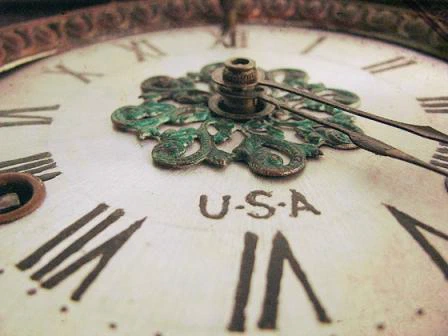
It’s been two days of physical therapy now, back to the running-back-and-forth-to-the-hospital state I was in at the start of the semester. Lying on a warm hospital bed, receiving a moderate electric stimulation, I actually felt a bit dazed.
I started to wonder what kind of space-time I actually exist in. Some people would say, don’t we have calendars, phones, and the like to tell us the time? Sure — the bottom right corner of my computer desktop clearly shows the time right now, the year, the month, the hour, the minute. But I’m still not satisfied. I don’t believe in time. I don’t believe it flows linearly, I don’t believe it definitively divides past from future, I don’t believe I exist within this “time.”
The famous Einstein gave time a rather poetic description: time is curved. When you stand at one end of time and look back at the beginning, things at the other end might really appear vividly before your eyes. There’s a line of verse that goes: back then, it seemed only ordinary. Bygone time appears like this, suddenly, at another point later on — coming hastily, and leaving just as hastily. So much of our longing, our reminiscing, springs from these glimpses of old time we catch.
There are many triggers for these images — most often a sentence, a face, a song… These things get processed by your current experiences. What we call being “moved by a scene” or “reminded of someone by an object” arises from this processing of such things. But often the “old” thing being processed was never something we actually possessed — so why do we long for it?
When Hacken Lee sang “Heart Scheme,” I wasn’t listening to Hong Kong pop — that wasn’t my “old.” When Leo Ku sang his love songs, I paid no attention — that wasn’t my “old” either. When Jacky Cheung released In Love I wasn’t even born yet — even less my “old.” And then there’s The Weavers’ “Kisses Sweeter Than Wine” — that couldn’t possibly be my “old” either… Yet every time I hear these, I’m stirred by the notes within them, and feel an emotional resonance.
The same goes for painting, film, and other art forms — too many examples to list. I think a great deal of “the old” belongs to humanity as a whole — it can cross time, cross races, cross oceans, and be passed on to many people. What was originally just an individual’s emotional release ends up becoming our collective nostalgia. But is this “old” really “old”? It might be, like time itself, simply something fabricated by human beings. Even if you can find meaning within it, is that meaning obtained through a fabricated object?
Or, put another way — where does the meaning of meaning itself lie? I can only sigh — what time brings us really is a strange thing!