From So You’re Not Unhappy After All to the Power of Voice
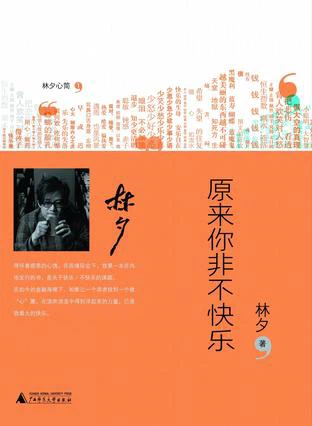
This noon, Lin Xi’s book So You’re Not Unhappy After All finally arrived in my hands. Honestly, this kind of book is rather bourgeois-lifestyle, and such books rarely make my reading list — but since the author is Lin Xi, I bought it to take a look anyway. As expected, it turned out exactly as I anticipated: Lin Xi’s prose reads as if he piled up all his lyrics together and turned them into complete sentences, dressed up with current affairs, yet still unable to shed his characteristically delicate touch.
This book dissects all sorts of small things in life, framed around the pursuit of happiness, but really it’s teaching us how to face the various unhappy factors in life so as to find peace within it. It carries a touch of Zen, almost like it’s guiding us toward enlightenment. Of course there are many similar books — the ones that come to mind are The Book of Life and After Ecstasy, the Laundry. But I feel Lin Xi’s book falls far short of those two in depth, whether in its overall structure, its details, or the insight it offers — it’s told in a gentle, meandering way, but lacks any distinctive substance.
And yet So You’re Not Unhappy After All has already gone through four printings in a year — just look at the comments on Douban to see how many people are chasing after it, while other books attract far fewer readers. This brings to mind the issue of the power of voice. Of course you might say you don’t know Lin Xi, but surely you’ve heard Faye Wong’s “Red Bean,” Sandy Lam’s “At Least I Still Have You,” or Eason Chan’s “Love Transferred” — at the very least, you’ve heard “Beijing Welcomes You” — all these lyrics came from Lin Xi’s pen. His influence is clear to see.
Precisely because Lin Xi possesses such enormous power of voice, the book most people end up seeing is this So You’re Not Unhappy After All. So often it goes this way — the “latecomer” easily overtakes and replaces the “first to arrive,” and this is exactly the power that having a voice grants.

Whether the earth would really tremble three times at someone’s roar, I don’t know — but ever since old Mao said that famous line, it really has, under certain circumstances, become “truth” for some people, forming an invisible yet immensely powerful force. Things like “all Chinese people the world over roar as one, the earth trembles three times,” or “oil workers roar as one, the earth trembles three times,” and so on. There are many similar phrases like this, repeated endlessly by us or by certain institutions until they became so-called “science” — and we owe all this to the power of a strong voice.
But if you think carefully about what these people are actually saying, is it really useful? In my view, far too many people bask in the spring breeze granted to them by their power of voice, prattling on endlessly all day, when in fact it’s not worth listening to at all — pure nonsense (this reminds me of high school…). These people are nothing more than yes-men under the sway of that power, the oppressed beneath the powerful, and the nonsense they spout is stale and old, utterly devoid of original insight.
As Li Yinhe put it (see “Keeping a Diary Like Thoreau”), one should make good use of one’s own power of voice, think with purity, and speak according to one’s conscience. This is really something many “leaders” need to understand — when speaking on behalf of a student union or a school, must it always be so full of self-congratulation? Less boasting, less exaggeration. But in the end, there’s still a great deal that cannot be said, no matter where you stand or what position you hold. I wonder if this counts as one of the saddest things under humanity’s rule?