Great Letters: From A to Z, the Glorious History of the Alphabet

Great Letters: From A to Z, the Glorious History of the Alphabet is a book on the history of language that’s both scholarly and accessible. It not only explores the pronunciation and evolution of letters, but also answers fun questions like “why does x represent the unknown?” — the reason being a compromise made by 17th-century printers due to a shortage of French y and z type pieces — and even resolves a few puzzles found in linguistics. For instance, “ma” is said to be the most basic sound infants first produce, true the world over. When a baby says “ma-ma,” it carries no meaning of “mother” at all — it’s adults who absorb it into their own vocabulary. And so, in Mandarin Chinese “妈” (ma), Hindi “maa,” Vietnamese “me,” Malay “emak,” Hawaiian “makuahine,” Swahili “mama,” Finnish “emo,” Hebrew “ema,” Basque “ama,” Quechua “ma” — across all these utterly unrelated languages, you can still hear the flavor of “ma.”
Beyond that, the author also includes the symbols of some minority communities. For example, “Q” stands for “queer,” and StageQ is a queer theater troupe. Even the fact that “Zorro” means “fox” in Spanish is dutifully recorded. Truly, the book reaches into every corner, leaving nothing out. The pity is that the book’s design and binding are a major letdown.
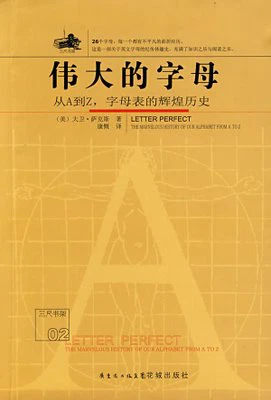

The Chinese edition’s cover appears to inherit the base color scheme of the English edition, both trying to convey that sense of the vast culture embedded in written language. But the illustration chosen for the Chinese edition is quite problematic — you can even see jagged, pixelated edges (not ruling out that this might be some intentional pixel-art style). At the same time, the text alignment is also done poorly, giving the feeling of an unfinished proof copy.
The design of the English edition’s cover, while not going for a flashy visual style, uses an interwoven grid and decorative text symbols of various colors, and the overall color scheme (including the text colors) gives off a strong sense of cultural weight.
The cover issues might be secondary — the interior page design is even more dreadful.
I dislike the cloud-pattern background in the table of contents, and the margins at the foot of the body pages are too narrow, creating a visually oppressive feel. As a result, you can find readers on Douban saying the more they read, the less they want to continue. And it’s not just the headers — the body text throughout is also quite small and cramped. This might be due to cost considerations for paper, but it’s not very comfortable on the reader’s eyes.
In addition, the chart designs all come across as rigid and lifeless — though this is a common ailment among many mainland books. For instance, comparing the “World Script Genealogy” chart on page 8 with the “Text Network” found inside the cover of Yukimasa Matsuda’s Zerro (Taipei: Net and Books, 2007), the difference in quality is plain to see.
Lastly, I’ll mention that the translator did a truly excellent job! Many thanks for the wonderful translation — I gained a great deal from it.