Idly Tapping Chess Pieces as the Lamp-Flowers Fall
Listening to these old Hacken Lee songs is like reading poetry — you shouldn’t read too much of it at once, and not a single piece should be rushed through; it needs to be savored slowly. Some need a leisurely afternoon, some a quiet, bitter night, some a long stretch of love-struck, dust-bound life.
“A Lifetime Unchanged” has been sung at every one of Hacken Lee’s concerts, and the version from the 2002 Qingqing Tata concert is my favorite. It might as well be a poem — one worth chewing over and savoring again and again. Lee’s clean voice, accompanied by the piano, comes across so composed and gentle, the lyrics flowing slowly, washing away the murk and decay within one’s feelings, like trickling clear water, or pure white milk.
That year, in 2002, Lee handled the tempo just right — not too fast, not too slow. He sang it again later, but the tempo had slowed to the point of impatience. Or perhaps, for a song like “A Lifetime Unchanged,” slowing down doesn’t carry the same significance as when Jacky Cheung made “Big Events in a Small Town” entirely his own — but it left a deep impression on me all the same. I feel I’ve come to understand what “slow” means: born slowly, growing up slowly, maturing slowly, declining slowly, dying slowly.
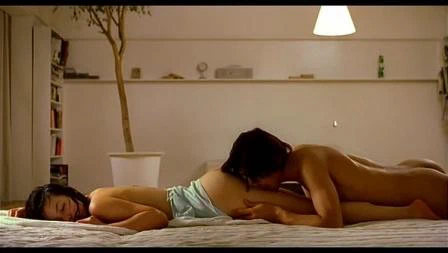
A scene from the opening of La Belle (2001) suddenly flashed through my mind. A very clean, lingering moment — against a pure white background, one motion in, one motion out, its rhythm as natural and gentle as breathing, like gusts of cool wind. At the very start of Slowness, Milan Kundera writes that “speed is the form of ecstasy that the technical revolution has bestowed on man.” Set the machines aside — what, then, is our own pure, unmechanized speed?
In the Song dynasty, a man arranged to meet his male friend for a game of chess and conversation during the plum-rain season. But his friend never showed. Frogs croaked away in the green-grassed pond, and he felt a bit downcast, so he began playing chess alone. By midnight, he noticed the world outside his window had gone pitch black, and the table was scattered with fallen lamp-wick ash. The scene must have been quite beautiful, and yet someone went and called it “anxious waiting.” Was Zhao Shixiu really so desperate? What a way to ruin the mood!
Anxiety is far too postmodern an emotion. But ask yourself — in today’s world, who could possibly sit calm and unhurried enough to feel the “slowness” of idly tapping chess pieces as the lamp-flowers fall?