One Person’s Endpoint
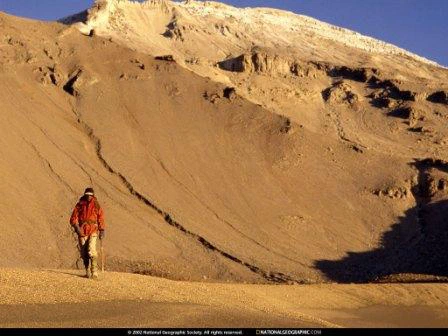
I can no longer recall exactly when the scenery in this photo was taken. Pulling up the precise record from the digital camera might tell me which exact day it was, but I don’t want to do that. The mechanism of human memory ought to be a kind of filter — whatever it cannot hold, the useless things, eventually get culled away by itself. That’s how I think about it, and that’s how I’ve acted. Emerson once said that the landscape belongs to the one who looks at it. I think memory should work the same way — belonging only to those people or things worth remembering.
The photo shows a winter mountain scene. I still remember that long road, where everywhere the eye landed was mottled gray-yellow gravel and sand, and even the grass was just withered, dried-up weeds. The sun was fierce, scorching the skin, but it still felt warm enough. Occasionally I’d come across a shriveled cactus, its edges already yellowed from lack of water, its few remaining spines withered too. Oh, and there was a moderate wind along the road. This was the first journey I ever took alone, and also the first time I’d left that city that always seemed to be moldering, never touched by sunlight.
I don’t know if it’s some kind of inborn trait, but I really love sunlight. As a child, the grown-ups told me not to look at the sun, but I paid them no mind, always staring at it for a long while by myself, until my eyes simply couldn’t stay open. Everyone said I was a lonely child, that I should have loved the moon instead, but I just loved the sun — maybe because there was no mold in my heart, none of that white, fuzzy stuff. Later on, a lot of things happened that were also tied to sunlight, but unfortunately I don’t remember much of it now.
I don’t know how long I walked before arriving at that youth hostel. Stories sometimes work that way — beginning right where they should end. The only room available was a triple, and though I wasn’t thrilled about it, I checked in anyway. Sharing the room were a man and a woman, apparently a couple. But I found them rather childish — talking, in this day and age, about things like “childhood sweethearts” and “till the end of time.” In my eyes, they were just part of the scenery.
“Let’s eat and turn in early” — that’s what the man said, and it suited his “cold” image well enough — a big black overcoat, a black scarf, sharply pressed black trousers, even his shoes were black. But the more I looked at him, the more he seemed like someone who’d been splashed head to toe with black paint, hastily fleeing the desert under cover of night. Thinking about it, I couldn’t help letting out a snicker. He turned and looked at me, as if waiting for me to say something, but I said nothing. He probably just went back to his meal, a bit deflated.
It grew dark, and the stars came out. I walked outside and looked up at the bright night sky. A night like this made me think of that moldy city. Insects, bright stars, a breeze… it all seemed like just a kind of disguise — by night everyone has to face the matter of sleep, the same way an aging creature must eventually face death. This inescapable “sorrow,” in whatever form it takes, is something I deeply dread — the transformation from today into tomorrow is a kind of painful metamorphosis.
I went back to the room. The luggage was scattered all over the floor, but they weren’t in the room. I was glad to enjoy a bit of solitude on my own.
What also troubled me was the new bed. I’ve always believed that a bed has a life of its own. Sleeping in a new bed is like sleeping with a stranger — you need to find the right position, the right posture, even the right timing, and if you think about it further, you start wondering who else has slept in this very bed throughout history — a pretty, refined young woman, or some filthy vagrant? My experience has been that by the time I’ve thought all this through clearly, the sky is already getting light.
And another thing — why does everyone say I’m withdrawn? Because as a child I basically didn’t talk, whether at home or at school — when there was nothing to do I’d just read or zone out — and this “zoning out” I mention here was only outward; inwardly, I was off fantasizing. Like wondering whether my sister would taste good if turned into beef jerky, or what it would be like if all the buildings were golden. My not speaking doesn’t mean I can’t — I just hoard up my words, and when alone with a good friend I’ll let them all out in one go, then sink back into silence again.
I’d been watching TV for a while when she came back, alone. She told me he was her cousin, but he’d had to leave early for something, and asked whether the two of us could share a room tonight. I found it odd — shouldn’t that kind of suggestion come from the guy? It occurred to me that this would be the first time I’d ever shared a room with someone else overnight, and that this person was — what I’d originally assumed was a stranger man’s girlfriend’s — younger cousin. I emphasized “cousin” because some part of me, subconsciously, was glad their relationship was a little more distant than I’d thought?
After she finished speaking she stood there for a long while, as if waiting for my answer. I liked looking at her from this angle, because I could clearly make out the faint beauty mark at the corner of her lips, and her face, half-familiar, half-strange. Observing someone this closely, this intimately, must have been the first time in my life I’d done such a thing. Time passed quickly — just a few seconds slipped by like that. Maybe she felt embarrassed under my gaze, because she suddenly, hastily, picked up the newspaper off the floor and walked away.
It turns out that leaving, sometimes, can also leave one pleasantly intoxicated. For the next few minutes I sat frozen like that, staring blankly at the TV without knowing what was even on. The next time I saw her, she had already shed her clothes.
A portion of the middle section has been lost
She gasped strangely, and I touched her lips, still unable to hold back, and told her, “I like you.” She didn’t answer — she just held me tightly, tight enough that it hurt a little. At that moment the sun was covered by a kind of dark red light, as if it too were in pain, weighed down. On the ride back, gray-yellow gravel and withered cacti alternated past the window, repeating that tedious, unbearable scene again and again. Thinking of how quickly time flies, my eyes grew a little damp.
We played all day and were both starving, so we ate a lot of grilled meat, our mouths greasy, laughing at each other, and kissed for a long time with the taste of the grilled meat still on our lips. After dinner I went back to the room alone to watch TV — though really I wasn’t watching TV at all, just waiting for her. The glow of the setting sun still lingered, very much like something about to fall behind a curtain; somehow this kind of atmosphere always seems to call up scenes of lovers parting, but while others usually part on a happy note, she and I had no idea what the future held.
She finally came back, gently closing the door and gently turning off the light — her slow movements made my heart race. At that moment I felt like I was on a roller coaster, unable to tell whether it was fear or excitement. The wind outside was very gentle, the curtains rose and fell slowly, letting through moonlight that was sometimes milky white, sometimes pale blue, which cooled my heart considerably, and before long I drifted off to sleep. Deep in the night, in a daze, beneath the thin, faint moonlight, I seemed to see her figure, as if gradually receding into the distance.
The next morning when I woke up, the scattered luggage had been tidied up neatly. She was nowhere to be found, only a letter left at the head of the bed.
This letter can never be sent, so I’m leaving it with you instead. I will remember you — that night was my whole life, a memory worth spending an entire lifetime to look back on. Do you know? That night actually hurt quite a lot, and I didn’t sleep all night, hoping so much that you’d hold me for a while, but you never woke, and didn’t even notice when I kissed your forehead. By the faint moonlight, I asked you: is there anyone else out there who would stay awake all night just like me? You only answered with a soft murmur. Outside, every now and then I could hear the sound of some animal moving, a long, dragging sound across the ground, spaced far apart, just like the rhythm of what we were doing.
Before dawn, I pressed my ear against your now-softened little bird, fast asleep, and I couldn’t hear even the faintest birdsong from it. I kissed it, and there was still a trace of fishy, fresh scent. I knew we would eventually part, and I felt I had to take this step. Before leaving, I reached my fingers inside myself, trying to ease some of the pain, but it was held so tightly, and I knew that was a pain that would stay wrapped around me for the rest of my life. I’m leaving now, carrying your salty taste with me, and perhaps the fluid you left behind too. I don’t regret anything that happened these past few days — we were both waiting, weren’t we?
One afternoon in spring, five years later, the sun was warm, and I moved a chair out to the balcony, looking at the sky, the sun, the clouds, every now and then able to hear the sound of children playing. From the neighbor’s windowsill drifted a cool whiff of mint — perhaps mint can sometimes be even hotter than chili pepper! I thought of how she used to ask, and I would answer; how I would turn cold, and she would fall silent. An indescribable stillness suddenly surrounded me, as if it had taken on physical form, and it frightened me terribly.