The Chef of South Polar Station
For someone like me, who’s always wanted to learn to cook but has never had the chance, and is too lazy to make the chance — watching a film about food is the best substitute. In The Chef of South Polar Station, a handful of men stranded in the ice and snow of Antarctica find that their daily meals are the best way to dispel the loneliness of their long stay. As I’ve said before, cooking is a state of mind. Through this kind of communication that’s almost like language, the protagonist finds his own happiness in seeing everyone else satisfied.
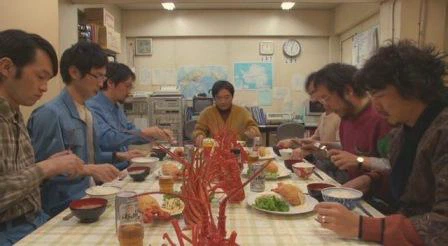
The film is full of “treasured” foods — out in Antarctica, where ingredients are never in short supply, the men feast freely on steak, lobster, rice balls… I’m not much of a glutton myself, but even I felt my mouth watering.
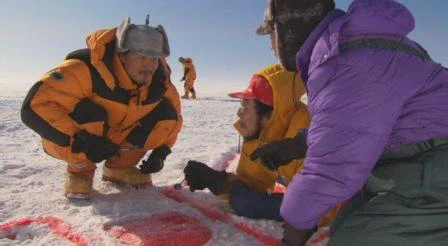
This is the scene I found most amusing. The men pour fruit juice onto the ice to mark out the boundaries for a baseball game, but the mixture of juice and Antarctica’s pristine ice crystals turns out to make excellent shaved ice. Watching three grown men, like children, lying flat on the ground scooping up “shaved ice” with spoons — wouldn’t you want to try it too, come winter?

Maybe it’s because I love ramen myself, but the uncle in the film who can’t go a single day without a bowl of ramen struck a real chord with me. Looking at it now, cooking isn’t just what I used to think it was — there’s also the mood of the person eating wrapped up in it. See something delicious, and your spirits naturally lift. In the film, when the uncle has no ramen to eat, his face goes gloomy. The so-called communication of food and drink is, more or less, exactly this.
Speaking of cooking, it reminds me of Still Walking, which I watched last year (see “Nothing Out of the Ordinary”) — if Hirokazu Kore-eda’s film is like a refreshing little snack, then this Chef of South Polar Station is a rich, hearty feast you simply can’t turn down. The “sentiment” it carries goes even further than Still Walking — it dissolves a barrier that humanity has never quite managed to overcome: loneliness.