The Open Splash
A word is dead. When it is said, Some say. I say it just. Begins to live. That day. –Emily Dickinson, 1830-1886
The poem carries none of the worldly (some say) anxiety, fear, and anguish about death; instead it views death from the angle of rebirth, a starting point. For the poet, contemplating life, death, and love is like a woman’s lifelong pursuit of slimming and whitening her skin—it never ends. For most people, the span between life and death is nothing more than a straight line segment, with “birth” at one end and “death” at the other. But under such a view, the deeper meaning of death is often obscured. Life should in fact be a straight line, and what extends from both ends is precisely “death”—the very thing human civilization has so often treated as taboo.
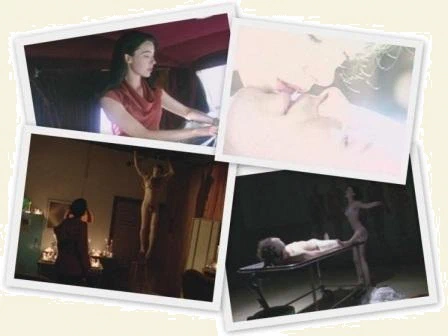
The 1999 film Kissed, directed by Lynne Stopkewich, interprets certain deeper meanings of death and desire from the perspective of a necrophiliac woman.
The protagonist, Sandra, loved burying small animals as a child, performing special rites for them before they went into the ground. Her only friend was frightened away by these rituals and by the menstrual blood she shed. After that she returned to a state of solitude. As an adult, Sandra found work at a funeral home, which became the place where she continually released her desire onto the dead.
This naturally brings to mind Nekromantik (1996), but compared to that film, Kissed replaces bloody imagery with the inner desire of its character. Sandra’s desire is genuinely strange—intense, luminous, even carrying a faint whiff of the sacred when underscored by the music. In our own words, this treatment is very literary, very poetic. (Compared with the raw, unflinching realism of Nekromantik, I can’t really say which approach is the more accomplished one.)
On another front, Sandra falls in love with her classmate Matt at school. When Matt learns of her necrophilia, far from objecting or being shocked, he treats it with great respect. Yet he can never quite reach harmony with her in the act of sex. He wants to help turn her desire toward the living. But despite the enormous effort both of them put in, it ends in failure—Matt submits to Sandra’s way of expressing love, turning himself into a corpse.
I think Sandra’s desire resembles what the Greek philosopher Anaxagoras called “nous”—a force that, under any circumstance, points back toward itself, occupying a position of mastery unconstrained by anything else, and through this the spirit is set free. As the film puts it: looking at a bright light without being blinded. Indeed, neither Sandra nor Matt acted out of mere sexual desire; if they had, they could easily have satisfied each other. What no one expected was that genuine desire should prove so hard to attain.
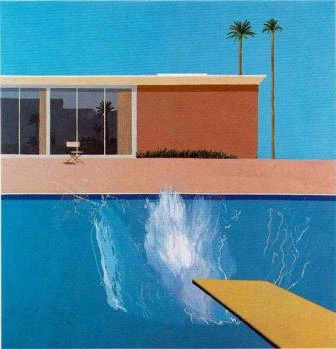
When desire gets entangled with death, many people find it strange, at most dismissing it as the fantasy of poets or the confession of misanthropes. But as said above, both the starting point and the endpoint of life ought to be death. In aesthetic terms, death is open—an eternal work left behind by biological evolution for humankind. What it gives us is never something prescriptive, but something expandable: the cry of birth cannot prove that you have lived; only death proclaims to the world that you once “lived.”
David Hockney’s painting A Bigger Splash is a work full of tension—the form of the splash contrasts sharply with the flat, straight lines of its surroundings. Its shape sets the mind wandering: some think of diving, others of a waterfall… It carries on an exchange of creation with the viewer, but you will never know what exactly caused the splash—only by diving in yourself could you find out. Isn’t death exactly like this?
I’m reminded of another line of Dickinson’s:
Until moss has reached our lips, and obliterated half our name.
I love lines like this—beautiful because of death, dead because of beauty.