The Pig That Wants to Be Eaten
Ever since I was little, I’ve been someone who likes to ponder all sorts of things. Besides wondering “where should I go play today,” I’d also find myself thinking about questions like “does God exist,” “what did dinosaurs actually look like,” “why don’t girls have breasts when they’re little”… As I grew older, I gradually came to ponder more and more questions — it’s probably the best way I have of passing the time. I understand exactly what Emily Dickinson meant when she wrote that the brain is wider than the sky, and deeper than the sea. To my mind, human intelligence owes itself to thinking, and the sheer complexity of human nature springs precisely from the differences in how we think.

There are plenty of people who spend their whole days pondering questions — we tend to call them “philosophers,” “scholars,” and the like, and our impression of such people is generally that they sit holed up in some ivory tower, researching things so profound they’re beyond reach. In daily life, the moment something gets associated with “philosophy,” people instinctively back away. The books such people publish come in every conceivable form, which only reinforces the idea that philosophy is impossibly deep and mysterious — something to be admired from a distance, never approached. In truth, the starting point of philosophy is nothing more than questions, big and small, deep and shallow. Think about them enough, and they’re not so difficult after all.
Russell, in The Problems of Philosophy, points out: “Philosophy is to be studied, not for the sake of any definite answers to its questions, since no definite answers can, as a rule, be known to be true, but rather for the sake of the questions themselves.” And these questions can liberate the mind from narrow prejudice, which has an enormous effect on changing and clarifying how we look at things.
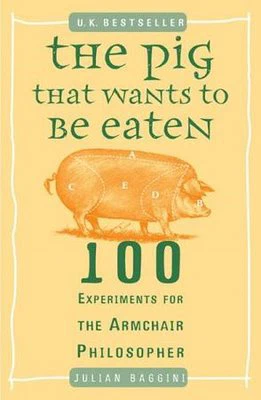
Julian Baggini’s The Pig That Wants to Be Eaten is built on exactly this foundation of “philosophical problems.” The author carefully designed 100 thought experiments to “invite” readers into philosophical reflection, to enjoy the pleasure of thinking philosophically. Some readers online have said that these are all questions without answers, and not worth thinking about. But to me, questions without answers are precisely what reveal the limits of human thought — they leave you with “nowhere to go,” and yet that’s exactly what drives you to keep progressing.
Another book in this vein is 101 Philosophical Problems, published by Xinhua Press. More recently, philosophy books have even been turned into comics — there’s one called The First Philosophy Comic Book (A Concise Comic Guide to the Philosophical Thought of the World’s Most Famous Philosopher, Nietzsche), also worth a look! (I once wrote down some thoughts based on the content of The Pig That Wants to Be Eaten before, but at the time I’d only seen a preview edition. Now I’ve finally bought the actual book, ha~ Some of the text above is also drawn from an earlier journal entry of mine)