Song of Apollo
Song of Apollo is a work by Osamu Tezuka, Japan’s “god of manga” and “king of manga,” completed around 1967. Everyone knows what kind of era that was — full of youthful, hot blood. It was likely precisely the vigorous energy bursting out of the student movements of that time that inspired this famous manga.
The protagonist is a young man utterly lacking in stability — Shogo Chikaishi — who acts on impulse without regard for consequences. When he’s sent to a psychiatric hospital, the case report describes him as a dangerous figure with “severe sadistic tendencies.” His mother’s promiscuity left him with a deeply negative view of love, and so the psychiatrist’s treatment goal is simply to teach him how to love. Yet his fate twists and turns endlessly: because he doesn’t believe in love, no matter how many times he is reincarnated, something always goes wrong right when he falls for a woman, ending things and leaving him “forever tormented by love.”
A friend recommended this to me. He thought it was a youthful, coming-of-age manga that might liven up my brain a little. Having finished it, it certainly did liven things up — but I’d argue this isn’t simply a youth manga at all, but rather a manga about the worship of procreation.
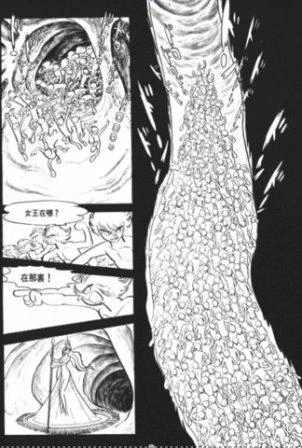
The prologue (“Union of the Gods”) contains an explicit depiction of sexual union: sperm racing in droves toward the egg. In the second chapter (“Paradise”), Shogo learns the broader biological meaning of sex by observing animals mating on the island. Afterward, his mutual affection with Naomi Watanabe, and the clone queen’s vow of love unto death, deepen this worship of procreation into the realm of emotion and thought.
The author’s line of thinking isn’t hard to trace: physiological → psychological; procreation → love. Whoever steps outside this framework gets punished. Some commentary calls this a work about adolescence — I don’t think that’s right. Shogo Chikaishi has someone he loves but cannot have; he doesn’t want to love, yet is forced into it; he despises mating, yet is eventually seduced into it successfully… is all of this really just adolescent business?
Schopenhauer, in The Metaphysics of the Love of the Sexes, wrote that the reason humans mate “lies within the essence of the object itself, beyond the reach of our own deliberation”; a man’s burning desire to sleep with a woman “is, in fact, not so different from sleeping with any other woman — nothing beyond physical union and reproduction is gained.” People who hold this view of love or procreation surely aren’t many — if they were, humanity would probably have gone extinct long ago. But that’s exactly how the protagonist was before his “cure.” And he was indeed “cured.”
I keep hearing a supposedly progressive view on sex education, which holds that when teaching adolescents about sex, more emphasis should be placed on sexual morality, sexual responsibility, sexual civility. But these are merely artificial facets imposed on sex from outside — once sexual pleasure itself is stripped away, sex education becomes a propaganda tool for a certain kind of discourse, and sex itself is reduced to a mere assembly-line lifestyle marching under that discourse’s iron heel — marriage, offspring, family, reproduction once more.
Taking it a step further, beyond the worship of procreation, this manga also carries a worship of the phallus. First, the protagonist is male, and the entire exploration of sex and reproduction unfolds from a male point of view. Second, the side that believes or disbelieves in love is also male — clearly, women have no right to choose love at all: even the clone queen, exalted as she is, still has her life controlled by another male clone. Third, the myth embedded within the story is itself steeped in patriarchy. The all-powerful, handsome, virile Apollo falls in love with Daphne, who has no right whatsoever to choose love or sex for herself, and is left with no option but to turn into a laurel tree, becoming the eternal object of male Apollo’s love.
For a manga, I’ve probably thought about this far too much. What a manga really calls for is simply: charge forward, for the queen! — Ha, that’s still nothing more than the rallying cry of some hairless biped.