To Drink Milk or Not?
Today I saw online the latest revised edition of the Dietary Guidelines for Chinese Residents (Tibet People’s Publishing House, 2010-12-01), billed as “the book that can add 5 to 10 years to a Chinese person’s life.” I’m not sure whether it’s just riding some new wave of rhetoric or not.
This reminds me of a few years ago, when I first came across this book and the milk powder scandal was raging. Anxious parents rushed their children in for all kinds of medical checks, while many voices kept demanding answers — did the regulators fail to regulate? If there was a problem, what exactly was the problem? In the end, all you might get is an empty, vague statement that something was “seriously wrong.” Can resignations alone really settle issues like these? Shouldn’t the culture of rewards without punishment be reformed — perhaps that’s one of the great distinguishing features of China’s officialdom. Of course, what I want to talk about today is something else, about milk itself. Do we actually need to drink milk?
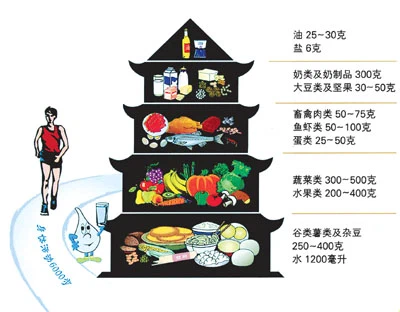
The very first page of the Dietary Guidelines for Chinese Residents is the Chinese Residents’ Food Pyramid (see image above). It states that one should drink 300g of dairy products every day. The book later spends a dozen-odd pages describing the value of milk. But is milk really so wonderful? Does it really need to be checked off daily like attendance at school? Actually, ever since childhood, in the (mainstream) nutrition books and periodicals we’ve come across, milk has been treated almost as a synonym for a cure-all. So does the universal principle that nothing is purely beneficial without any drawback simply not apply to milk?
Clearly it does apply. T. Colin Campbell, tenured professor at Cornell University, led a study spanning 24 provinces and 65 counties in China (later expanded to 69 counties) involving more than 6,500 people, examining the relationships between diet, lifestyle, and disease — the China Health Survey. Campbell, hailed as “the Einstein of the nutrition science world,” pointed out that casein, which makes up 87% of milk protein, can promote cancer — in other words, milk may be carcinogenic — and he advised people to eat more fresh vegetables instead. The survey further concluded that people who consume the most animal-based foods also suffer the most chronic diseases (including various tumors), while the healthiest populations are those whose diets are primarily plant-based. (See The China Study, 2006, and Southern Weekly’s article “On Diet, China Should Not Repeat America’s Mistakes”)
This kind of heretical claim seems to be rebutted in the Dietary Guidelines for Chinese Residents. The book states: Recently, some popular science articles, based on the results of foreign animal experiments or survey data from a small number of people, have promoted the view that drinking milk causes cancer, which has had a significant impact on our country’s residents. In reality, this view lacks scientific basis and does not align with our country’s actual circumstances.
This passage reads like a piece of writing heavily flavored with political damage control, and its evidence is far from sufficient. It makes only two points:
Humans and animals are different (a smokescreen, denying the similarities between humans and animals)
Chinese people drink less milk (another smokescreen — does drinking more make you somehow no longer Chinese?)
Dismissing every “heretical” claim out of hand is hardly a way to genuinely care about public health; it only leads us to speculate about what benefits certain statements from the nutrition association might bring. If this kind of attitude persists, then the appearance of toxic milk powder could likewise be dismissed as something affecting only a “small number of people,” lacking “scientific basis,” and “inconsistent with our country’s circumstances.” Must we really make this developing nation of 1.3 billion people take a great gamble, have the entire population serve as test subjects, sacrificing flesh and blood, just to trade it in for one truth?
Whether milk truly has value, from a purely nutritional standpoint, remains to be examined. But once it becomes a tool for a small number of people to profit from, every single drop of it becomes poisonous. And for an authoritative Chinese association responsible for the health of the entire nation to keep forcefully denying new viewpoints, rejecting new research, and revising a book that seems both worth consulting and not worth consulting — playing it safe, seeking no credit but avoiding all blame, clinging rigidly to convention — isn’t that, in itself, a kind of poison too?