Treasures from a Sea of Romance - Part One
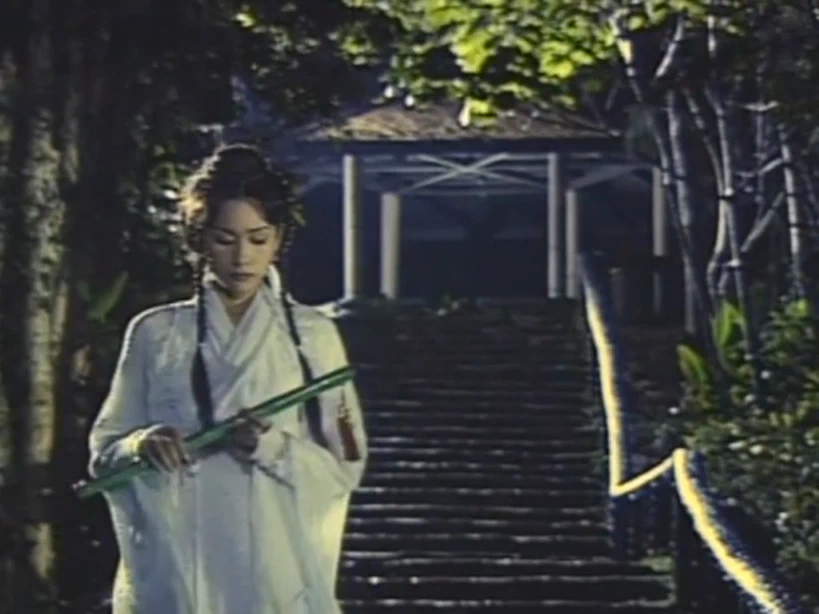
Adaptations of wuxia novels are notoriously hard to please everyone with — much like how “a thousand readers will picture a thousand different Lin Daiyus,” or how “liking” something is never simple, stirring up a tangle of complicated reactions both psychological and physical. The 1997 series The Romance of the Condor Heroes (雪花神剑) is a rare gem among them. Yang Gongru’s portrayal of Mei Jiangxue, in particular, carries a flavor strikingly close to the opening lines of Wang Daoqian’s translation of Duras’s The Lover: “I am already old. One day, in the lobby of a public place, a man came up to me…”
What left the deepest impression on me, though, was Nie Xiaofeng. What kind of woman was she, really? I keep coming back to this question.
Her family fell into ruin, yet she remained innocent at heart; she could be ruthless and decisive, yet she loved deeply; she was betrayed again and again, yet she never stopped trying. This is Nie Xiaofeng — a sovereign of her own corner of the martial world, quick to settle scores, and yet also a woman undone by her own infatuation, adrift and heartbroken. I feel for her deeply. Everyone pushed her away — the martial world, her own master, even her own daughter. But even the most wretched among us usually has a few loyal “supporters,” doesn’t she? Tian Xiang was utterly devoted to her, wishing only for an innocent love between childhood companions, but her particular brand of obsession had to play its cruel trick — splitting the one she loved from the one who loved her into two different people. The man she loved chose to leave her; the man who loved her, she let slip away, again and again. Unifying the martial world may have been her last dream, but it also wounded her more deeply than anything else. And that same obsession lured her back to Mount Ailao — a sweet, heartbroken place. Of course, that dream, too, went unfulfilled.
She believed her two children would be the continuation of her love, a bargaining chip to hold someone back — a notion both traditional and, frankly, pathological, yet another form of the “obsession” that gripped Nie Xiaofeng for so long. Her whole life was an obsession with love, an obsession with kin, an obsession with martial arts. Her eventual self-destruction, too, was a death born of obsession. You could say her entire life dissolved into that single word: obsession. As the sutras say, “Green bamboo, dense and verdant, is itself the Dharma body. Yellow chrysanthemums in profusion are nothing but prajna.” The rise and fall of Mount Ailao seems to have begun in obsession, and ended in obsession too.
@Filed under “Sea of Romance” —» “Treasures from a Sea of Romance”