AI and Creativity
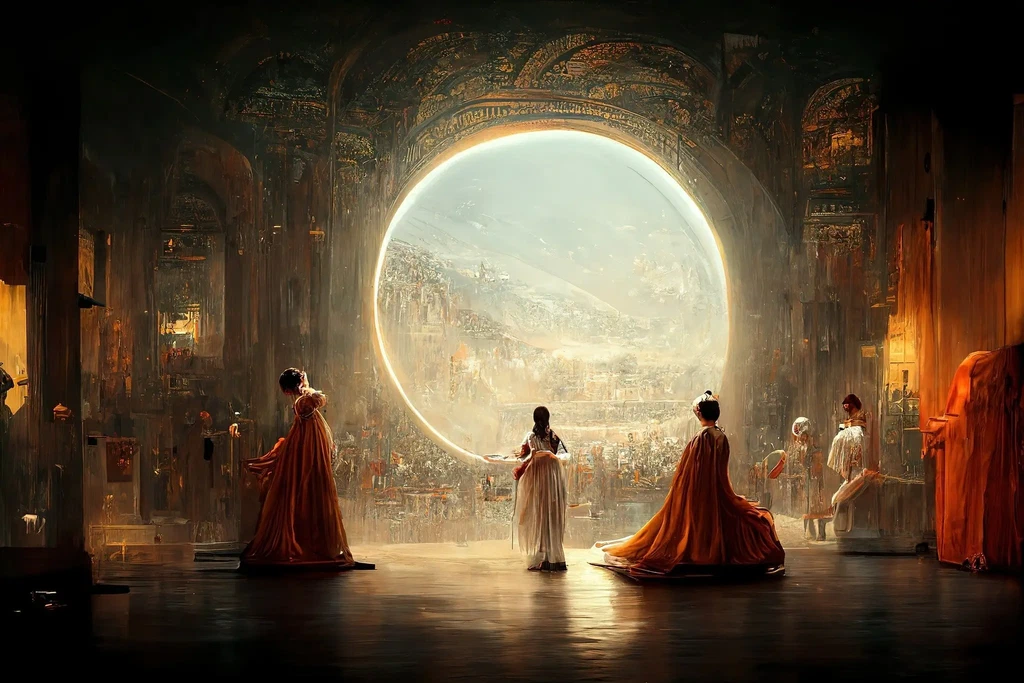
They say the great Mr. Artie Intelli once remarked: “Sometimes, a painting is just a painting.” Of course, it’s only hearsay. My own sense is that it doesn’t quite sound like something he’d say. Creators rarely volunteer the decoding key to their creations.
Looking at AI-generated work, the first impression is one of smoothness; the second, a kind of uncanny familiarity. The images feel like something you’ve seen before, yet you can’t point to where. That emergence from nothing — sometimes accompanied by a melody of unknown authorship — carries a distinctly “genesis” quality. Surrounding it is an obvious tension: does AI count as “real creativity”? Those in favor argue that creativity has always been, at its core, combination and recombination — AI simply does what humans have always done, faster and without fatigue. The mainstream view, however, holds that machines have no intention, no soul, and that what they produce is mere imitation and collage, unworthy of the word “creation.”
First, the word “artificial” derives from the Latin ars (meaning “skill” or “craft”) and facere (meaning “to make”) — literally, “made with skill.” Note that “art,” humanity’s proudest possession, and “artificial,” the word used to diminish machines, share the same root. So on what grounds does anyone use artificial to sentence art to death? One may say of AI’s work: this is soulless! But “soul” is something a person can know, at most, about themselves — it cannot be verified in another, let alone in a machine.
Second, I resist the essentialist lens — what I’d call the “pathologizing of creativity” — when applied to AI work. A person sits before a canvas and rearranges mountains, rivers, and light they have seen before. A model rearranges mountains, rivers, and light from its training data. At exactly which step do these two processes diverge? We cannot use the notion of “true creativity” to draw the border of “non-creativity.”
Third, on the question of originality and intention. Critics say: “It’s just recombination — there’s no intention behind it.” This view carries the shallow imprint of mainstream opinion: it betrays no understanding of how creativity actually works, while presuming to know what a machine “thinks” or doesn’t. It also conflates “tool” with “plagiarism” — by that logic, anyone who has ever borrowed from predecessors is a thief, and art history itself is the world’s largest warehouse of stolen goods. Consider this: through the continuous feeding, fine-tuning, and revision by human hands, the birth of a work becomes a natural, inevitable outcome. To say it has “no intention” — unless the speaker has taken a stroll through the silicon chips themselves — is equally unknowable.
But to bring it back: sometimes a painting is just a painting, and AI art is just AI art. In 2018, at Christie’s, a work titled Portrait of Edmond de Belamy sold for $432,500. In the lower-right corner, where a painter’s signature would be, there was no name — only a line of the mathematical formula that generated it. Someone pressed the question: who actually made this? The creative team shrugged and said, “Creativity is not an exclusively human trait.” Faced with an answer so honest it’s almost endearing, Mr. Artie Intelli — and by now you’ll have gathered he’s not a real person — could only smile and say: “Sometimes, a formula is just a formula.”