The Goldberg Variations
I’ve recently been watching a YouTube channel called “The Boring Life of a Musician.” Classical music is a tangled, difficult world, and for a complete beginner like me, channels like this are far more welcoming.
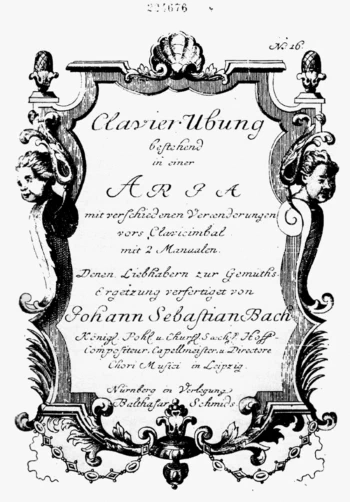
A search on Google turns up countless versions of the Goldberg Variations — harpsichord, organ, clavichord, piano, and recordings by famous performers across every era. A hundred fingers couldn’t point to just one. On Reddit you’ll find comments like: I thought this version suited my taste perfectly, and then suddenly I heard another, and it was an entirely different sky. It’s hard not to admit that human perspective is always too narrow, capable only of being slowly stretched wider. We are to music what an eye is to a forest — the more we possess, the more leaves there are blocking our view ahead.
As for Bach (J.S. Bach), there’s probably not much left to say. After his death he was crowned with honor after honor, yet in life he was, in truth, rather pitiable. Even so, people still love to compare him to his contemporary Handel (G.F. Händel). In German, “Bach” means a small stream — a thin trickle that never stops; “Händel” means merchant (from Fifteen Lectures on Music Appreciation, Xiao Fuxing). It’s hard to deny — Handel really was a good deal wealthier than Bach :). Hendrik Willem van Loon writes in his biography of Bach:
Handel, as a composer, drew far more attention than Bach… and people generally considered his life more interesting than Bach’s… people always loved to gather in the homes of distinguished German masters and opera-house managers. As for Bach, his rooms were nearly bare, furnished with a few simple pieces, and guests were rare…
Historically, Bach and Handel never actually met. They were practically neighbors, born only a month apart; Bach visited Handel’s hometown more than once when Handel returned to see his mother; Bach admired Handel deeply throughout his life… and yet, they never crossed paths. It can’t help but recall the plot of Jimmy Liao’s Turn Left, Turn Right.
Bach stayed in the countryside leading a choir and writing his own music; Handel traveled abroad, touring one country after another. Perhaps it was precisely this humility and restraint that allowed Bach’s music to speak to the soul — beyond religion — since he could never have been as aloof or hot-tempered as Handel. Of course, he wouldn’t have wanted to be. Bach, one imagines, always kept his composure, sitting calmly, never the type to have his wig fly off in a fit of rage like Handel. Later, people grew used to saying Bach’s music carries a religious air; later still, people found in Handel’s music that same sense of faith and reverence.
Having said all this, I’ve fallen into the old trap of comparison myself… ah, it seems simply listening to music for its own sake is never quite possible. Only by setting aside comparison and bias can one actually be moved. Perhaps I’ll add a new tag after this, to record the interesting history I “hear” along the way.