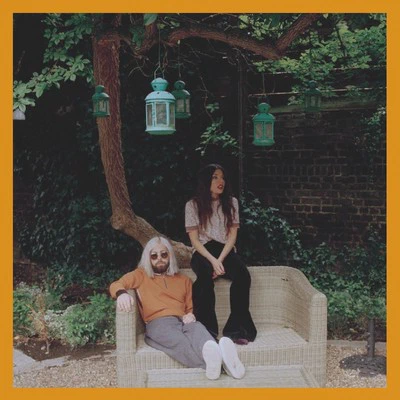
Shpresa Lleshaj and Cole Randall came together in 2012 through an exchange of comments on Soundcloud. Lleshaj is from Kosovo, having fled to Sweden with her family as a child to escape war, while Randall is from Minneapolis, USA — and ever since, the name Flora Cash has carried a certain transatlantic estrangement, the feeling of two people recognizing each other across a screen. Their music sounds like two people, each having wandered on their own, letting their guard down after finding one another. The band’s melodies carry a faintly DIY recording texture — acoustic guitar, simple drums, and of course Lleshaj’s slightly fragile voice — giving off a strange beauty that is both candid and careful at once, a quality Flora Cash has never lost since their breakout song “You’re Somebody Else.”
Their newly released EP, Your Best Boy, is a work of increasingly settled style — plain-spoken yet faintly hesitant, its mood restrained and well-judged. The interplay of guitar and drums shows its own character across the different tracks. In the title track “Your Best Boy,” two verses lead into a chorus sung over and over — “I’m your best boy” repeated again and again — with harmonies that show a mature level of production. The line tucked at the end of a verse, “Don’t you wanna run?”, reads like an unsettled note on a feeling — at times certain, wanting to sing the promise with more conviction, at other times adrift, as if not yet ready to hand over complete trust.
The album The Silver Lyre, produced by Lorna Govier and Anne Kilmer, is a remarkably rare find. Many people who’ve studied human history know that the oldest writing system was invented by the Sumerians — cuneiform — but far fewer know that the oldest complete piece of written music is a set of cuneiform songs inscribed on clay tablets.
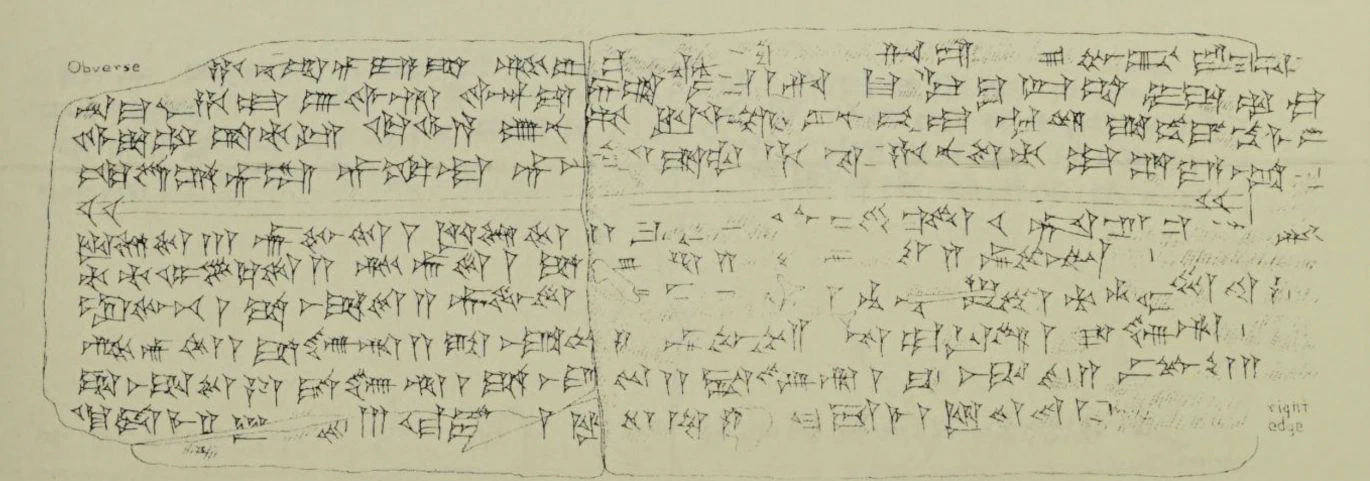
The album’s track “A Hurrian Cult Song” is based on Assyriologist Anne Kilmer’s decoding of the Hurrian cult songs found on cuneiform tablets unearthed at Ugarit. Kilmer made significant contributions to this formidable task, matching the interval instructions on the tablets against the syllable counts of the Hurrian lyrics to derive something resembling a “natural scale” melody.
The song text as transcribed by Kilmer
The interpretation of these cuneiform musical scores remains a contested topic in academia. While the tablets clearly record the names of the strings and the interval instructions, the Hurrian language itself is an extinct linguistic isolate, so there’s no single agreed way to translate these symbols into concrete rhythm and melodic movement. Some scholars argue for a pentatonic-leaning chant; others claim a more complex polyphonic logic lies behind it. Near Eastern archaeology, it must be said, remains a field charged with both passion and controversy.
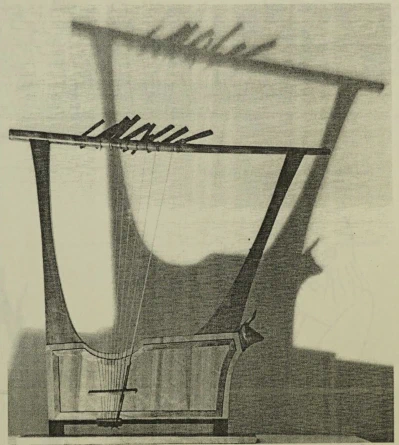
Photograph of a replica of the Silver Lyre, made by R.R. Brown
The instrument used on this track is a modern replica based on the “Silver Lyre” unearthed in 1927. The working model of this ancient instrument was originally conceived by Kilmer and built by R. R. Brown of the physics department at UC Berkeley. Its frame is made of red birch, and its soundbox of spruce. The strings are traditional gut strings, running over a bridge on the soundboard and anchored at a bottom block. For tuning, the tops of the strings wrap around a crossbar and oak pegs — twisting the pegs applies leverage to adjust string tension, allowing for fine pitch control.
Imagining how this might have sounded in the 14th century BCE, the album’s performance is probably too modern, layering in a fair amount of imagined “ethereal” and “sacred” atmosphere, and the harp parts carry a touch of contemporary scoring polish. Still, none of that diminishes its artistic value.
Part of this introduction is adapted from Sounds from Silence: Recent Discoveries in Ancient Near Eastern Music, 1976.
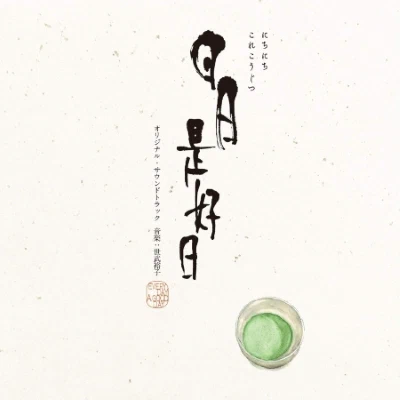
Every Day a Good Day (日々是好日, 2018) is a film adapted from the memoir of Japanese tea ceremony instructor Noriko Morishita. At twenty, Noriko began learning, in a tea room, how to fold cloth, rinse bowls, and pour water — coming to understand, through repetition, the discipline behind every small gesture. Noriko was no prodigy; she was ordinary, hesitant, and for a long stretch of time, unsure what the tea ceremony even meant. In that narrow tea room, she learned to tell apart the subtle difference in sound between hot water poured into a bowl in summer and cold water in winter, learned to listen to rain on rainy days and watch clouds on clear ones. Those seemingly tedious, day-after-day rituals were, in fact, time made tangible…
By the end of the film, Noriko is no longer the lost girl peering in from outside the tea room, nor is she still troubled by the meaning of life — she has become part of the tea room itself: tranquil, yet holding a quiet strength; old-fashioned, yet moving with the seasons; silent, yet brimming with life. The film’s theme song is deeply soothing, and paired with the story, it makes you feel time itself slipping past.
As for the history of matcha, it’s a “bitter” journey of migration, craft, and culture. As early as the Tang dynasty, the Chinese were already steaming tea leaves, drying them, and grinding them into powder to drink with water. The Song dynasty developed the practice of “dian cha” (点茶) — placing tea powder in a bowl, pouring in water, and whisking it with a bamboo whisk until foam rose. In the Southern Song, the Japanese monk Eisai brought Chinese tea seeds and this mature “whisking” method back to Japan. As the practice in China was gradually replaced by loose-leaf brewing, Japan elevated it into a full ceremonial art. In pursuit of the most vivid green and freshest flavor, tea farmers developed a distinctive technique: shading the plants under trellises before harvest so the leaves, starved of direct light, produce more chlorophyll and amino acids; the leaves are then ground slowly on stone mills into a fine powder with a silky texture, without damaging the aroma.
For centuries, the tea ceremony served as a spiritual anchor for samurai, and embodied the Zen idea of “ichigo ichie” — one encounter, one chance, never to be repeated. These days, of course, matcha has transformed into the darling of the wellness and baking world :)
This animated film is adapted from the autobiographical graphic novel of the same name by Colombian illustrator Power Paola. It tells the story of Paola breaking free from the constraints of a conservative South American middle-class family.
Paola’s very birth was treated as a kind of “miracle” — doctors had told her mother she’d already gone through menopause, and even referred to the child in her womb as a “tropical virus.” Because her father had once been a priest, her childhood was shadowed by religious conflict and family upheaval. In high school, she and her mother left Ecuador for Cali, Colombia. Far from home, Paola went through the usual confusions of adolescence. In Cali — a city both seductive and turbulent — she experimented with drugs, lived through the disillusionment of first love, felt the hardship of striking out on her own, and worked hard to find herself through art. After graduating, Paola packed her bags amid the chaos and said goodbye to her family…
The soundtrack, composed by Adriana García Galán, blends Latin indie rock with psychedelic folk — a nostalgic mood thick with tropical humidity, bittersweet yet full of life. Paired with the film’s raw, sensitive black-and-white hand-drawn animation, it becomes deeply affecting.
We’re always inclined to label the world as continuous. We build logic and causality, trying to find a “reasonable,” “stable” timeline in memory. And yet, what’s truly worth remembering is so often the sudden, the senseless event. A string of accidental occurrences happens to assemble into something called “me,” which only deepens the confusion: why me, why now, and not some other moment? Seen through an existentialist lens, this confusion is itself a kind of luxurious illusion — everything is simply contingent.
That contingency is unsettling (and also strangely captivating). If everything is random, then are choice, effort, even suffering, all meaningless? In truth, our existence is nothing more than an accident. The accident carries no emotional color of its own — it simply happened. But just as probability theory exists within mathematics, people always seem to find some curious balance between chance and certainty.
Speaking of the song “On Saturday Afternoons in 1963,” I love this lyric from Rachel Yamagata: as far as you ever wander, you end up back home… and while it stings a little, thinking of Cao Pi’s line — “life is but a sojourn, why burden it with worry” — might ease that feeling somewhat.
I’ve recently been watching a YouTube channel called “The Boring Life of a Musician.” Classical music is a tangled, difficult world, and for a complete beginner like me, channels like this are far more welcoming.
Cover of the first edition
A search on Google turns up countless versions of the Goldberg Variations — harpsichord, organ, clavichord, piano, and recordings by famous performers across every era. A hundred fingers couldn’t point to just one. On Reddit you’ll find comments like: I thought this version suited my taste perfectly, and then suddenly I heard another, and it was an entirely different sky. It’s hard not to admit that human perspective is always too narrow, capable only of being slowly stretched wider. We are to music what an eye is to a forest — the more we possess, the more leaves there are blocking our view ahead.
As for Bach (J.S. Bach), there’s probably not much left to say. After his death he was crowned with honor after honor, yet in life he was, in truth, rather pitiable. Even so, people still love to compare him to his contemporary Handel (G.F. Händel). In German, “Bach” means a small stream — a thin trickle that never stops; “Händel” means merchant (from Fifteen Lectures on Music Appreciation, Xiao Fuxing). It’s hard to deny — Handel really was a good deal wealthier than Bach :). Hendrik Willem van Loon writes in his biography of Bach:
Handel, as a composer, drew far more attention than Bach… and people generally considered his life more interesting than Bach’s… people always loved to gather in the homes of distinguished German masters and opera-house managers. As for Bach, his rooms were nearly bare, furnished with a few simple pieces, and guests were rare…
Historically, Bach and Handel never actually met. They were practically neighbors, born only a month apart; Bach visited Handel’s hometown more than once when Handel returned to see his mother; Bach admired Handel deeply throughout his life… and yet, they never crossed paths. It can’t help but recall the plot of Jimmy Liao’s Turn Left, Turn Right.
Bach stayed in the countryside leading a choir and writing his own music; Handel traveled abroad, touring one country after another. Perhaps it was precisely this humility and restraint that allowed Bach’s music to speak to the soul — beyond religion — since he could never have been as aloof or hot-tempered as Handel. Of course, he wouldn’t have wanted to be. Bach, one imagines, always kept his composure, sitting calmly, never the type to have his wig fly off in a fit of rage like Handel. Later, people grew used to saying Bach’s music carries a religious air; later still, people found in Handel’s music that same sense of faith and reverence.
Having said all this, I’ve fallen into the old trap of comparison myself… ah, it seems simply listening to music for its own sake is never quite possible. Only by setting aside comparison and bias can one actually be moved. Perhaps I’ll add a new tag after this, to record the interesting history I “hear” along the way.
The soundtrack to Gods and Monsters feels deeply somber from beginning to end — much like the somberness of James Whale himself. It carries so much: his dying, his career, his Frankenstein… and, of course, his unconventional sexuality.
In Michael Cunningham’s words, for James, the time that remained “doesn’t belong to him, which is why he thinks about killing himself.” This recalls, in some strange way, the old man with Alzheimer’s in The Father. As time and the palace of memory collapse along with the disease, he weeps: my leaves have all fallen. Seen through that comparison, his sudden death becomes a little easier to understand.
Anyone who’s seen the film knows there’s an unspeakable bitterness to how he dies. James’s body is pulled from the pool by Clayton, who, fearing he’ll be suspected of some connection to him, pushes the body back into the water. Watching the body drift weightlessly on the surface, sunlight everywhere — it hardly looks like death. It looks more like a dance. This track, “Last Swim,” records the violin melody that plays in that very moment. I think it’s a moving scene.
Gods and Monsters — which one is the god, and which the monster? Maybe listening will offer a different answer.
Over a career spanning more than fifty years, John Waters has long since moved from the fringes of subculture into the mainstream, while still holding onto his singular anti-idol sensibility and aesthetic across his filmmaking, writing, performing, and photography. Of course, an aging mind inevitably accumulates a stash of old, stale things, and the single “It’s a Punk Rock Christmas,” released in 2024, is no exception.
As far back as 2004, John Waters first brought his particular spirit to a Christmas album: A John Waters Christmas. The record is both very traditional and very novel. If you’re tired of “Silent Night” or “White Christmas,” here’s a change of pace. I’d always assumed John Waters, with his seemingly “punk,” rebellious image, must have a very traditional side to him too — and this album confirms it.
He puts his peculiar talents to use on these decidedly disreputable tracks, songs like “Here Comes Fatty Claus” and “Santa! Don’t Pass Me By” — things we’ve never heard, or have forgotten we ever heard, or wish we could forget. This obscure assortment, spanning everyone from Tiny Tim to the Chipmunks, Fat Daddy, Rudolph and Gang, and plenty of other never-popular artists, makes for an ideal sweet little “antidote” to the holiday season — irreverent, mocking, and entirely its own thing.
John Waters tours every year around Christmas, and this year he happens to be coming through Boston! In an interview he once said: “Close your eyes, and imagine you’re at my house on Christmas morning, listening to your favorite carols with me…” Not the most Dickensian image, perhaps, but the spirit running through the album turns out to be far more traditional than you’d expect. Still, it seems most people remain partial to the old standard carols, sleigh bells and all.
As the year draws to a close, let me borrow his words: wishing you a merry, filthy, dreadful, sexy, multiracial, hilarious, happy little holiday season!
Saying this now is probably out of season — a cold wave is sweeping through New Hampshire while, on the other side of the country, wildfires rage — which only goes to show just how varied North America’s climate really is.
The deep-winter wind seems to have drifted into YouTube Music too, with all the “lonely, cold, and tragically beautiful” artists rising to the surface. Well, that’s fine — a little cooling-off does no harm. I’ve been listening to a lot of Tori Amos lately, and this song, “The Pool,” left an especially deep impression on me. As eerie as PJ Harvey’s The River, yet with a different sound entirely… which gets me thinking about poets, and about the soul.
A Lancet article last month pointed out that a “stroke-reviving” traditional Chinese medicine showed no significant benefit over placebo in patients with acute cerebral hemorrhage. Trying to make sense of traditional Chinese medicine through double-blind trials strikes me, more often than not, as a futile exercise. In the philosophy of Chinese medicine, everything is connected to everything else. Amid one chance, random event after another, logic becomes a pile of expensive scrap. Its devotees, meanwhile, like to insist that traditional culture is mysterious, unfathomable, beyond words. The opposition and endless bickering with modern medicine leaves one exhausted and gets nowhere. Science can treat the person, but it cannot save them.
Religion sits above the fortress of science; its nobility and its calling are things science can hardly reach. Scientists, more often than not, find their inspiration through theological revelation. In his later years, Newton devoted himself painstakingly to theology — research that, for Newton, may have carried far more meaning than any apple ever did.
Mozart’s Coronation Mass (note: a “mass” here refers to the music sung during a Catholic Mass) is clearly the result of just this kind of religious calling, and of Mozart’s own devout self-cultivation. Mozart was going through a hard time then — financial crisis, the death of his mother, a failed love affair — all of which gave the still-young composer a deep sense of the cruelty and helplessness of social reality. What help could he seek? It seems only religion remained, comfort sought through devout prayer. The Coronation Mass has far less pomp and splendor, and far more of the genuine feeling and depth of an ordinary person experiencing real grief. It is moving.
This live recording is Karajan conducting in 1985 at the coronation ceremony of Pope John Paul II, with video of the performance available as well. Compared to some other well-known versions (such as Trevor Pinnock’s), this one is much slower in tempo, but that pacing suits the atmosphere of a coronation mass perfectly — a kind of baptismal restraint that other conductors, or even a younger Karajan, would have struggled to achieve. Listening to it, you can almost glimpse the Mozart of that time — a Mozart cornered and helpless.
It’s time, time, time… this murmur is what I fear most. Click to listen
Early this morning I watched the clouds in the west drift up like smoke, curling skyward — it reminded me of the scene where Mcdull’s mother is cremated, that slowly rising plume of black smoke. Aging, oh, aging. I can’t deny you’re a natural process, and I can hardly change the fact that I’m just another product on this same assembly line — but I still resent you. When we’re young we don’t know what it means to grow old; once grown, we fear growing old; only in old age do we finally accept it.
The Big Bang produced the universe, and the universe is still expanding, so the world is in motion. Because of that motion, time arose — or so it would seem? Einstein said that moving at, or even beyond, the speed of light would make time stand still, even turn it backward. So, chasing after sunlight — could that make a person young again?
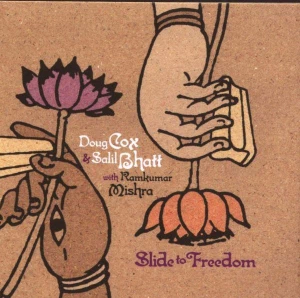
Slide to Freedom has truly absorbed the essence of late-1960s San Francisco counterculture. This album, brought to life by Doug Cox and others, blends Mississippi blues with Indian music. It crosses genre boundaries, because sometimes — rarely, of course — the music itself is everything. From the beautifully sliding “Pay Day” to the bustling “Meeting by the River,” this group of musicians is something special.
“Pay Day” is the perfect opener. Doug Cox’s voice differs slightly from that of a Mississippi Delta native — there’s a faint roughness and tremor to it, but it suits the music perfectly. Cox’s guitar and Bhatt’s Mohan Veena play off each other with a simplicity that’s also wondrous, arguably outshining every other acoustic blues record out there…
They say this CD was made by “the gathering of many talents,” and that’s no exaggeration — there’s plenty of unseen, unheard work behind it. Cox himself notes on the sleeve: “These aren’t ordinary musicians. Forming a free musical collective with players of such extraordinary gifts is one of the bright spots of my career.” The music on this record is more than mere words — it’s a covenant between people and gods.
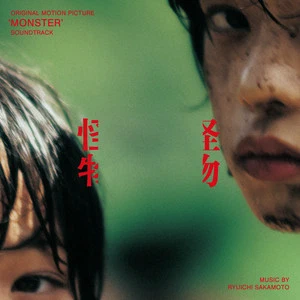
Hirokazu Kore-eda’s 2023 film Monster (かいぶつ). A single mother suspects her son, Minato Mugino, is being bullied, takes it up with the school, and finds herself in an endless tug-of-war with the teacher involved. Meanwhile, the tangled relationship between her son and a classmate, Yori Hoshikawa, unravels piece by piece.
The film opens with a fire in the busy part of town and closes on a calm, settled note. Fields, blue sky, white clouds, children walking carefree to school — everything signals the quiet peace of this small Japanese town. It reminds me of the town of Spectre in Big Fish, where people hang their shoes on the wires and live happily on soft green grass. Even the houses are painted in cheerful, cozy colors. But the extreme conservatism hiding in people’s hearts there is also part of what makes it a small town — no ambition left, idleness shading into boredom, a poet who can no longer write poems. Such a town is undoubtedly the product of a fairy tale, and also its end.
If Big Fish is built on a fairy tale, then Kore-eda’s Monster carries more of a social edge: a surface calm riddled underneath with holes, full of sanctimonious posturing. A dead cat is examined in close, careful detail — set alight, you can almost smell the corpse; the principal, who seems so meek and deferential, may have killed her own granddaughter; the boy’s dead father is “fashioned” by the mother into a role model meant to inspire her son’s growth, when in fact he died unexpectedly while having an affair… At the same time, the film is full of details worth lingering over, with a distinctly psychoanalytic flavor — the little drawing that falls to the ground midway through with the word “monster” scrawled on it, the wall covered in students’ handprints, and of course Kore-eda’s signature warmth, which always leaves you thinking long after the credits roll.
This OST (click to open) is full of understated color, yet shot through with something mysterious and eerie. Aqua renders that uncanny mood to the fullest. Listening to the score, it’s easy to picture the scenes of Minato and Hoshikawa together, as if it forms a strange feedback loop, breaking you apart bit by bit and then putting you back together bit by bit. A mood of melancholy, strangeness, and dreaminess lingers in the ear like a dream itself.
Flower (2017) is a film about adolescence. Its young protagonists are sunlit and full of restless energy — equal parts unrestrained freedom and matching bewilderment. The film’s protagonist, Erica, and her chaotic family and search for identity, echo things we’ve already seen elsewhere in novels and film. Mishima Yukio’s unrestrained outpouring of his adolescent self in Confessions of a Mask comes to mind as a similar example, and they’re not rare; even the final flight to Mexico recalls a similar scene in Thelma & Louise (1991)… and yet films like this still manage to charm us, because the longing for a reckless youth belongs to nearly everyone. Still, the brightest spring scenery always ends up darkened by some stain of color.
This song, “Fade Away” (Susanne Sundfør), is achingly lovely, though the desolation and melancholy in it are even more pronounced than in another track from the soundtrack, “Unfuck the World” (Angel Olsen). If you know the film well, listening to it will bring the relevant scenes right back to mind. youtube link
If life were a gift you could inspect before accepting it, I imagine most people would politely decline. In Sartre’s No Exit, three people are locked in a single room, tormenting each other, each one hell for the others. No wonder Sophocles, Byron, and others believed that never being born at all is the best way out. Schopenhauer said life is like a landscape painting — passable from a distance, but unbearable up close. So what, then, could possibly count as happiness? In truth, happiness in life is an illusion; there is only suffering, and the absence of suffering. Writing this, I seem to be sliding into extreme pessimism, and yet that’s exactly how it is. Faced with these inexplicable moods, we’re better off being pessimistic than being calmly rational about them. Life is this empty, and this absurd, and on top of that absurdity there are always vast numbers of people speaking, acting, and punishing others without the faintest idea what they’re doing. This absurdity isn’t human nature — it’s the nature of nothingness itself: we fear that everything we do will turn out meaningless, and we fear that our goals will dissolve into nothing. And as for what we call “things outside ourselves” — what are they, really? Nothingness, probably, as well.
This track, “The River,” is hazy, ghostly, almost haunted by a grievance that won’t rest. It can’t help but make you wonder: who, exactly, would ever ask for a “gift” like life? (youtube link)
Life, broadly speaking, has two recurring movements: intake and output. Intake is material; output is expression and feeling. The album is called Hide-and-Seek (迷藏), and as I understand it, that’s exactly the meaning split across the two characters — 迷 (lost): lost in intake; 藏 (hidden): output hidden away. These days, are people just endlessly taking things in, while neglecting to put anything out? Maybe the relentless pursuit of “worldly success” really does come from a lack of security — but eat too much and your stomach swells, you throw up, you don’t want to move, and eventually you have to find some outlet to relieve it all. (youtube link)
I love the way Yu Dafu piles up his words. Reading his “Sinking” (沉沦) before, I was struck by the melancholy that rippled through his prose. In truth, everyone’s life, piled up out of trivial “plot,” can’t help but eventually reveal an unbearable melancholy and helplessness. Suddenly, I’m reminded of the very first line of “Sinking”: lately he’s felt pitifully cold and alone. This song, Lonely Boy, stirred something in me, so I’ve rendered a free translation of it here.
Alone, this man, his soul adrift, his form withered. Mired in gloom, dwelling apart, he wanders at will, lost in himself.
Food and clothing he lacks not, yet in his distraction he gazes toward the void, forever longing for spring, to dissolve his sorrow and sighs.
The song seems to tell an ordinary but slightly sad story. Is there a house in your heart? Maybe it’s the house you grew up in, or one tucked away in a dense metropolis, or one facing a sea washed clean and blue, or one standing alone in an endless field. Someone lives inside it, always hoping to keep you there with simple, warm words, but the result is invariably the opposite of what was hoped for — what’s left in the end is always that same hollow emptiness described in <Air Doll>. And yet, what it brings is a quiet, watered-down calm. Is this what they call the nervousness of returning home?
@On Categorizing I remember Cheer Chen once sang: greatest-hits albums always mislead us, correctly, about where we’re headed, scrambling the implied order of things — really, listening through from the beginning is still the shortcut that gets you lost. I never understood what that line meant, not until I tried to become a “collector” myself, and only then did I gradually grasp some of its meaning. Sometimes you hear a lovely bit of background music, but pulled out of its context it’s no longer as beautiful, no longer as pleasing to the ear. That’s it, isn’t it — excessive polishing or curation costs you the wholeness of the thing. So I’ve named this “Sleepless,” to keep a record.