A Modest Menu

food

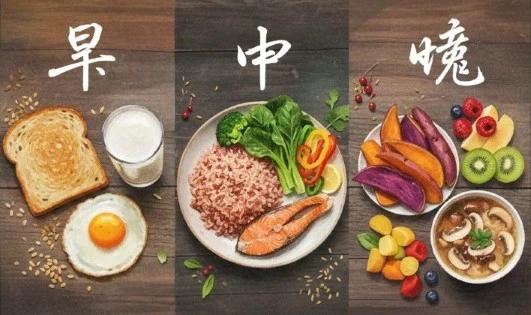
Having finished our study of nutritional chemistry, and wishing to put it to practical use… at the end of it all, here is the best menu I can offer you:

  • Morning: whole grains/mixed grains, milk (or soy milk), one egg.

  • Midday: brown rice, plenty of seasonal vegetables, a little fish or meat.

  • Evening: root vegetables, a warm light soup, a small amount of seasonal fruit.

Symbolized

logitech pop keys

Seeing this Logitech POP Keys keyboard, I find myself wishing so many things in life could be simplified this way. For eating, we could draw a symbol of a meal; for writing, a pen; for sleeping, a person on a bed; for happiness, a smiling face; for sadness, an ugly face; for love, a little heart… All of food, clothing, shelter, and travel could be expressed in full.

End of 2019

A few days ago I had dental surgery and could only eat liquid food, so I made a lot of smoothies with the blender. Once it settled, it turned into a kind of paste — beneath that thick layer on top was a dense, viscous liquid. Drinking it, a cold sensation spread through my whole body. Come to think of it, it had been a long time since I’d paid attention to a sensation like that.

Now that the holiday season has arrived, I suddenly realize I’ve already been a working adult for a full year. The past year of work hasn’t transformed me into an entirely different person living a life of toil, indulgence, and numbness, but there has certainly been change. The most obvious one is the shift in the information I “consume” every day. At lunch, many of my coworkers kindly recommend apartments to me, telling me which areas are a good deal and worth buying into; others recommend insurance, funds, and other ways to manage my finances; still others teach me how to save money… Maybe I just haven’t been socialized to that point yet, but I keep feeling that things like houses, property, and cars — while necessary to have — aren’t things I particularly want or care about. Of course, people who do care about these things are making their own choice, and I have no right to project my own preferences onto judging others. Money is an external thing, but my concern for what’s “internal” to me has also been dwindling by the day.

What, then, counts as “internal”? The body is nothing more than blood, qi, meridians, and the five viscera and six bowels — beyond that, there’s really nothing else. Happiness, joy, delight — these may just be simple chemical reactions in the brain; thought, philosophy, consciousness are likewise nothing more than a smoothie blended from your actions plus your reading and reflection — thick, clumpy, leaving even you a little bewildered. In the end, what a person really has is just solitariness: a single, unique object consisting of a body accompanied by consciousness.

Honestly, life is both small and rarely meaningful — there really are few things worth doing. One’s personal pursuits and preferences are, at best, a sip of sweetness tasted from the smoothie; some people, perhaps, are simply carnivores at heart. In the vast ocean of society, there really are people who are entirely worldly, who go through the motions, who simply repeat whatever everyone else says. It makes you wonder: is the point of socialization to step outside the collective, or to erase one’s own individuality?

The content of my work leaves me muddled — every day I’m endlessly deconstructing protocols that, to my mind, are already falling apart. We’re all supposed to analyze clinical trial results objectively, but in practice everyone is quite subjective. Thinking it over carefully, though, maybe it doesn’t amount to much difference. We’re merely observing the subjective using a method that calls itself objective. Or perhaps the source of it all is, through and through, objective, and it’s people who hysterically “fabricate” all sorts of — “data.” About a hundred years ago, Freud, that madman of psychoanalysis, wrote a short essay, “On Transience.” After criticizing poets who weep over fallen flowers and changing seasons, he generously pointed out that flowers that wither will bloom again, and houses that collapse can be rebuilt. Clearly, this old man, too, had a thoroughly objective eye (of course, the evidence for that goes well beyond this one point — but glimpsing the man through a short essay fits Freud’s own style of “seeing the large in the small”).

Work is, after all, nothing more than a process of trading effort and intelligence for money — even the head of state does the same. There’s not a trace of self-consolation in saying this. I can fully empathize with the mindset of someone who fails, who suffers, who struggles — how could such a person possibly cling to professional pride? What use is so-called “ambition” or “aspiration”? So, speaking from an uneconomical, irrational, purely self-centered point of view, it’s simply that I haven’t gotten my mindset straight yet.

I’ve rambled on without much logic. For 2020, though, I hope to live a bit more consistently, to be someone who keeps things calm and settled. Today I happened to run into that line from the Old Testament — “For dust thou art, and unto dust shalt thou return.” Even though I’d read it before, even though it’s a famous line, it still gave me a small jolt — dust was once such a solemn thing!

Dream

Berlioz attempted suicide at twenty-three over the agony of unrequited love, and survived to write the Symphonie Fantastique. I, on the other hand, had my sleep interrupted by a single dream.

I dreamed of some people, as if gathered in a classroom, sitting together watching a movie. Everyone’s face was stern and cold. I saw “myself” asleep, face down on the desk, yet I clearly knew that “I” was crying in the dream. I looked into her eyes — so close, and yet so unreal. We faced each other in silence. Perhaps I couldn’t bear the oppressive weight of that gathering any longer, and I woke up. A flood of words gathered at the bottom of my heart, and I didn’t know what to call any of it.

The past can be like this sometimes — interesting, able to take on any shape it pleases. It arrives without asking my permission, leaving me room to look back. I suppose it should be good to be able to look back — human instinct drives us to forget the unhappy things, so what we see when we look back tends to be the happy parts. But sometimes I find myself confused: is the dream an exit from reality, or is reality an exit from the dream?

I know that within that embrace in the dream, “I” was dreaming.

Thus Spoke the Bacteria

I have lived in seclusion for days, weighed down by a vast shame

I cannot face the world I once tore apart

The painkiller cannot wipe away the blood it left behind

The antibiotic cannot cleanse the stain etched into it

My share, of sinful entropy

As a certain doctor once said, pain is merely a symptom — its true nature is rarely as simple as the sensation of pain itself…

Please Don’t Ask About Loneliness

Whenever someone asks me if I’m lonely, I never know what they expect me to say. The question embarrasses me, because I can’t give a vivid, easily digestible answer that I myself, let alone anyone else, would find satisfying. From one angle, life is a solitary, bitter journey — lonely through and through. But shift the angle slightly, and you might catch sight of all the color along that solitary road, and find yourself marveling at how beautiful life can be. Solitude is a state; loneliness is a state of mind. In theory, a person should be able to adjust their mindset, turn it positive and hopeful. And yet the aloneness we’re born into guarantees a loneliness that never quite washes off. This, I think, is where my deep sympathy with Air Doll comes from — it’s also what we, flesh and blood, share with the plastic body of an air doll: an emptiness at the core.

Let’s suppose, for argument’s sake, that life is meant to be lived joyfully, that every day should be bright and brilliant. This optimism sounds like something off a cheap advertisement, and it falls apart under the slightest scrutiny. Forget every day — we can’t even guarantee that every minute within a single hour is bright and brilliant. Maybe some people really can think this way, like islanders on some remote isle who feel content as long as they’re fed and warm. But does that mean they’re free of loneliness? Quite the opposite, in my view. The islanders’ devotion to carrying on the family line, to keeping the ancestral fire burning, is itself a strenuous effort to fend off loneliness — whether in the process or in the result. Zoom out further, and the entire history of humankind looks like a history of killing time. We raise sheep in order to slaughter them; we slaughter them in order to eat them; eating mutton speeds up the body’s decay; decay leads, eventually, to death — and only then does an individual’s loneliness finally come to rest.

In the banned film Salò, or the 120 Days of Sodom, there’s a scene where the rulers force the boys and girls to eat their own excrement. I believe that in a sufficiently primitive society, such a thing could really happen. But once taboos around waste emerged, things grew complicated. As I see it, the means by which humans fend off loneliness run counter to simplicity and directness. Looked at this way, feces might actually be the most efficient source of nutrition — but to keep loneliness at bay, humanity still had to build an entire elaborate edifice of nutritional science, and from there, animal husbandry and everything that followed.

Loneliness may be humanity’s last taboo — something none of us are allowed to dwell on. Most people’s strategy is to avoid it, resist it, despise it; some, on the other hand, treasure it, even love it. The former strive desperately to find meaning; the latter strive just as desperately to pursue meaninglessness. But the starting point, either way, is loneliness — because it’s only once we’re lonely that we start to wonder whether anything means anything at all.

A New Blog

I spent an entire afternoon tidying up my old stuff and preserving as much of it as possible here. Unfortunately, since Blogbus shut down its log-export feature, my old comments couldn’t be carried over. A few notes:

  • This is already my seventh blog, so I’ve named it “Fox’s Seventh Studio”;

  • I’m using the static site generator hexo, with the apollo theme, hosted on github;

  • The sign-in methods provided by disqus are all blocked in China, so I’ve disabled comments;

  • The Blogbus link in the menu is there purely for “nostalgia”;

  • Some links in old posts are already dead; fixing them would take too much time and effort, so I’ve left them as is;

  • The order of posts from 2010-2015 has been thoroughly scrambled by me — if you spot a “paradox,” just have a laugh about it.

You never left

<You never left>by YN

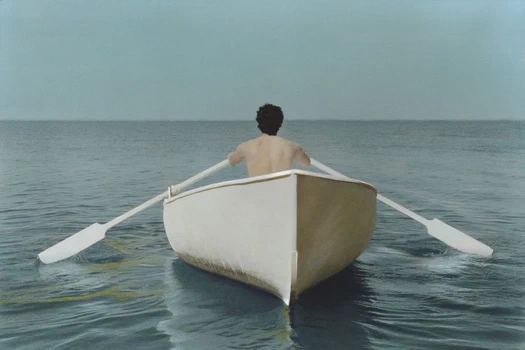
Love requires seizing power, requires building something, requires being led into opposing factions, even requires revolution. People who can truly carry a career through to the end are admirable — but people who can carry a revolution in love all the way through, while still feeling fresh excitement every single day, are almost nonexistent. Perhaps it would be far better for a person to spend their whole life hidden away in a small room, or aboard some broken-down boat.

A Fun Drawing Website

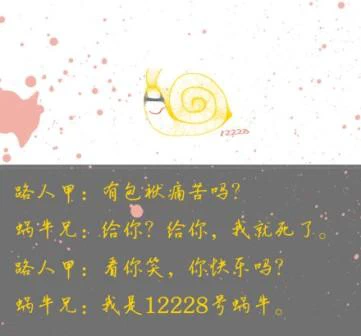
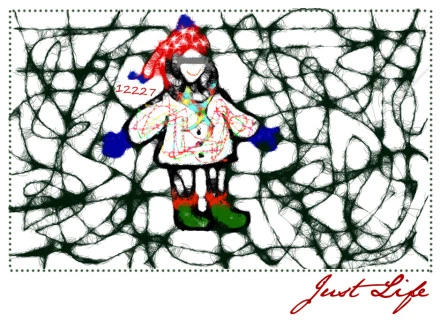
“Corners of the mouth turned up — who cares what kind of light is really flickering in your eyes. If others think you’re happy, then naturally you’ll think you’re happy too. If someone asks whether you’re happy, you must smile and tell them, yes, I’m very happy.”

Last night Yeliu recommended a drawing website (link) — I played around with it for a bit and found it pretty fun, though I’m too lazy and have no inspiration for drawing myself. I’m posting a few of her “masterpieces” here, and giving her a thumbs up.

Not Even As Good As a Dog?

This was Jia Zonglin’s status update yesterday.

I remember learning from the book Dog Stories that Freud had quite a bit of history with dogs. For instance, when conducting psychotherapy sessions, he always kept a dog by his side, and the dog’s barking would mark the end of a session. Bringing a small dog into sessions also gave a measure of psychological comfort to shy patients who struggled to express themselves. Later, when Freud was old and gravely ill, his body gave off a smell of decay so strong that even the dog he loved refused to come near him. This pained him deeply. Why did Freud love dogs so much? Not just for their usefulness in his sessions, but for their utterly straightforward emotions — love or hate, nothing in between. Humans, by contrast, often can’t manage that at all. He once lamented over this: why can’t human beings love and hate the way dogs do? We’re never able to love or hate completely — love always comes wrapped in a bit of hate, and hate, at times, mixed with a bit of love.

So then — are humans really not even as good as dogs?

6.18

I’ve heard people say that overpopulation ruined life, and that sky-high housing prices ruined love. But really, population and housing prices are no more than a form of economic “conquest” — much like a colonizer’s conquest of a colonized people. Yet as the conquered, the local people still retain certain things that conquest cannot touch: ideals, convictions, traditions and customs. The real fallacy in saying that overpopulation ruined life and housing prices ruined love is this — as the conquered subjects of housing prices and population, Chinese people were not conquered by economics at all, but precisely by their own so-called ideals, convictions, and traditions.

Holiday

You come

and the capital is just the same

You don’t come

and the capital is just the same too

.

You wear an innocent, light smile

and a soft look in your eyes

watching me

and somehow this still doesn’t feel like love

.

Telling You

I want to tell you,

that really, I’m just like you,

I too carry a Golden Pavilion in my heart,

and when there’s no other way,

I will burn it down too.

One Year of Hu Zhai

Today marks exactly one year since I made my home on Bus (BSP). In between, for various reasons, I changed addresses once, and Hu Zhi Wu Zhai became Hu Lu Zhai. I can say that this year is the first time since I started blogging that I’ve kept a record this faithfully for this long. So many people have come and gone online, and I’ve met many interesting, strange, and lovely… net friends, who have brought no small amount of surprise to my life — that’s one of the reasons I keep writing. There’s a line in Eason Chan’s song “Today, Next Year”: to meet you in this lifetime, I’d gladly spend all my luck — I’ll dedicate that line to all of you lovely people on Bus.

You Say Innocence Is Hard

That year we were still so innocent, walking hand in hand through the bustling crowd. I held your hand tightly, as if afraid you’d be swallowed by the crowd. On our hands, fresh from stealing a taste of ice cream, a sticky residue of cream lingered, gluing our hands firmly together. You walked ahead of me, your short hair dancing strand by strand at the back of your head. In that vast sea of people, there were only the two of us, two young children. Today I came back to that same road, and there is nothing left but the crowd. Tears slide down, scattering in every direction in the air after the rain.

I am a beggar, a tiny, ridiculously stirring beggar. I have lost the girl I loved most.

Idly Tapping Chess Pieces as the Lamp-Flowers Fall

Listening to these old Hacken Lee songs is like reading poetry — you shouldn’t read too much of it at once, and not a single piece should be rushed through; it needs to be savored slowly. Some need a leisurely afternoon, some a quiet, bitter night, some a long stretch of love-struck, dust-bound life.

“A Lifetime Unchanged” has been sung at every one of Hacken Lee’s concerts, and the version from the 2002 Qingqing Tata concert is my favorite. It might as well be a poem — one worth chewing over and savoring again and again. Lee’s clean voice, accompanied by the piano, comes across so composed and gentle, the lyrics flowing slowly, washing away the murk and decay within one’s feelings, like trickling clear water, or pure white milk.

That year, in 2002, Lee handled the tempo just right — not too fast, not too slow. He sang it again later, but the tempo had slowed to the point of impatience. Or perhaps, for a song like “A Lifetime Unchanged,” slowing down doesn’t carry the same significance as when Jacky Cheung made “Big Events in a Small Town” entirely his own — but it left a deep impression on me all the same. I feel I’ve come to understand what “slow” means: born slowly, growing up slowly, maturing slowly, declining slowly, dying slowly.

A screenshot from La Belle, found on Douban (not from the opening, but this scene is both wild and tender!)

A scene from the opening of La Belle (2001) suddenly flashed through my mind. A very clean, lingering moment — against a pure white background, one motion in, one motion out, its rhythm as natural and gentle as breathing, like gusts of cool wind. At the very start of Slowness, Milan Kundera writes that “speed is the form of ecstasy that the technical revolution has bestowed on man.” Set the machines aside — what, then, is our own pure, unmechanized speed?

In the Song dynasty, a man arranged to meet his male friend for a game of chess and conversation during the plum-rain season. But his friend never showed. Frogs croaked away in the green-grassed pond, and he felt a bit downcast, so he began playing chess alone. By midnight, he noticed the world outside his window had gone pitch black, and the table was scattered with fallen lamp-wick ash. The scene must have been quite beautiful, and yet someone went and called it “anxious waiting.” Was Zhao Shixiu really so desperate? What a way to ruin the mood!

Anxiety is far too postmodern an emotion. But ask yourself — in today’s world, who could possibly sit calm and unhurried enough to feel the “slowness” of idly tapping chess pieces as the lamp-flowers fall?

Aching Neck, Spinning Head

The past two days I’ve been doing everything in a muddle, my neck trouble leaving me a little rattled, so I’ve taken to pretending I’m some great hero out of a wuxia novel, pressing acupoints to dissolve the pain. At my age my thoughts have grown rather tangled, and it seems this is the only way I can accept the “pleasure” of pain that heaven has given me. Love and hatred are probably the same — long since no longer things this numbed-out self of mine can possess, and pressing acupoints won’t help with those either. To borrow Duras’s words, the Stendhalian, the Balzacian, even the Proustian kind of love story — all of that has already become the past.

But I keep thinking: a person without feeling is really as strange as a pair of boys’ underwear missing the smell it ought to have. Everything I’ve been going through lately has brought the word “dream” to mind — I haven’t mentioned it in so many years, haven’t even thought it through carefully. I used to write essays about things like this, and they were all fake — what does it matter if you dreamed it, if you imagined it? After all, this reality where dream and truth can’t be told apart is just that objective — even a turd has to be pulled out through your own body.

My earliest, truest dream was to be someone who travels everywhere, wandering more of our earth, and then dying once I’d grown too old to walk further. Accomplishing nothing wouldn’t drag anyone else down with me — I think if a person has successfully sorted out eating, drinking, and sex, then they qualify as an adult. What I hate most is any collective, institution, or authority presuming to judge or define whether a person counts as a success or a failure. Still, thinking it over and over, there’s some ambition left in my heart after all, and some things I can’t help being tied to.

Maybe it really is just a coincidence, but several old friends have lately been telling me about opening their own little shops. How nice, to have a little shop — it would seem to be your entire world. This has tugged at my own fantasies too — what if I had a little shop someday… It would be a conceptual kind of storefront, the kind that makes you feel at home, or maybe the shop’s name would simply be “feel like home.” Warm colors, fashionable décor — I’d sell things by day and sleep in the shop at night. Let’s say it’s in Chengdu, where it drizzles a little bit every day.

(several hundred words omitted here..)

Ah, wasn’t I talking about ideals? How did my consciousness drift off into fantasy again — am I really unable to escape stream of consciousness? After all, fantasy can’t help me actually live, unless I become a writer and write books? Right, write books. If that were real, I suppose I’d have to go down that path of mixed praise and blame, even more blame than praise… and later a reader would show up, supporting me against the pressure of convention, and I’d be so moved, and later we’d commit suicide together, bringing my legendary life to its end.

Ha ha ha, has pain really become some kind of hallucinogen? Oh right, what should my little shop sell? I’ll just set out a cabinet with a hundred eyes, each holding some flavor of human feeling — one eye, one taste, each utterly different from the next. Dear customer, do you carry some secret ache from your youth? Come on in.

Notes on the Body

One.

When I took the beaded bracelet off my wrist today, I saw the shape of each little bead printed onto my skin — it was quite charming, so, narcissistically, I took a photo of it.

How could such a small string of beads carry such force, leaving a trace pressed into my body like that? When I take it off, will my arm feel sad? I wanted very much to keep that mark, but common sense about life tells me that’s futile. Surely I’m not the only one who has had such thoughts. Han Wo’s poem “Written When My Messenger Returned, Bringing a Silk Handkerchief as a Gift, Hence This Poem” contains a similar moment — though he was reluctant to part with the print of a red lip, while I can’t stop thinking about the trace of beads.

A few minutes later, the “印 etched into the flesh” recorded on my skin dissolved away, and my arm returned quietly to calm.

Two.

Life is only chance

Happiness and pain are the same

Let fate’s lines go to hell

In an instant —

The needle pierces the skin

Three.

I took a photograph of my own male member, and found, looking it over, something like a sense of “admiring one’s own reflection.”

The erect cock, the tousled pubic hair, the slightly swollen scrotum. Everything turns understated between black and white, taking on its own particular scenery. Like a mountain, like a shore, like an island, with an ancient pagoda standing among them and the night unhurriedly rising up behind.

A “filthy” thing, given a few extra strokes, becomes a small piece of work.

Four.

I remember once hearing it said that men generally like the hollow between a woman’s collarbones — that kissing there means a deep kind of love. But I can’t manage anything so lovely. What I love is here (picture).

Its location is really a poor one — almost no one pays it any particular attention; the alluring calf and the well-built thigh eclipse its light. If the leg bends even slightly, your hand sliding down the thigh will most likely skip right past it entirely. Standing straight, it becomes a small, taut bulge of muscle; the leg folded, it retreats lonesomely back into its hollow, pulled taut by the hard tendons on either side, like Christ on the cross.

Suddenly, I notice wrinkles have appeared there — two faint lines, faintly etched between thigh and calf. I salute you, the unnamed part of my body — subjective, never to be named, forever.

Am I a Cat?

I am a cat
this label will follow me from birth to old age

Pigs have their pens, birds have their nests
I have the bustle of the city

Look, I glance back with a smile
that seems almost like spring blossom
sending up little puffs of white fur

The eaves are my kingdom
hung all over with humanity’s bras
some large, some small —
yet not one of them fit to touch my fur

Look at my long flowing coat
brighter even than moonlight
even if I transformed into an immortal
people would still just call me a cat demon

Am I a cat?

Please, Speak No More of Love

photo/xiaoxiao
photo/xiaoxiao
The stars are vast and distant

yet never too timid to appear for fear of looking like fireflies

The firefly said to the stars

scholars say your light will one day go out

The stars made no reply

When we are at our most humble

is when we come closest to greatness

excerpted from Stray Birds

Infatuated with Adolescence

Call it pathological, call it obsessive — I remain infatuated with adolescence

The teenage years are such a beautiful phrase. Caught between the world of adults and children, we could be willful, fling ourselves about without restraint, eat ice cream until it was still smeared around our mouths, and find a warm hug or an affectionate hand close at hand whenever we wanted one.

I was just remembering, back when I’d just started high school, sitting in the neighborhood chatting over yogurt with a girl who loved TVB dramas (I suppose I still counted as a kid back then too) — talking about which series was good, which actor was good-looking… laughing together, snorting milk out of our noses together, that white sticky liquid spraying all over the two of us.

Maybe this counts as a kind of 'childhood sex play' — though it's nothing at all like what boys do!
Maybe this counts as a kind of ‘childhood sex play’ — though it’s nothing at all like what boys do!

In the blink of an eye, I’m nearly twenty now, and she no longer appears anywhere within easy reach of my world. After I changed my QQ number, I never bothered to look up hers again. If she ever thinks back on those scenes too, I’m stubbornly convinced she’d feel it more bitterly than I do — because she’s probably still living in that same neighborhood where we used to play for so long, that familiar yet faintly aching playground.

Is this flowing water, or is it time slipping away?

Where is she now? To me, that blurred space is exactly my own fading teenage years.

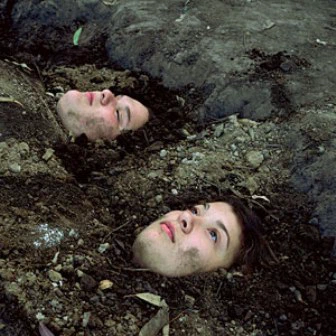
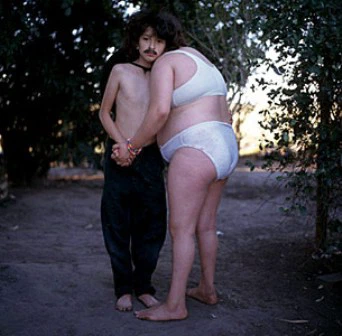
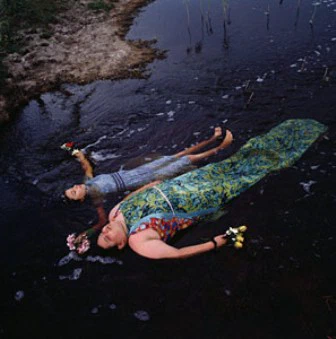
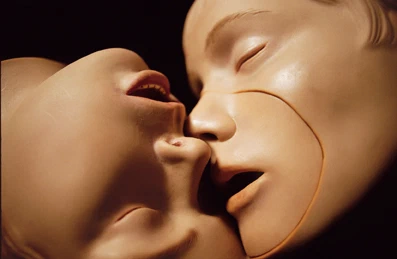
Just like those two sisters in the photographs, adolescence is one unfinished story after another, one rambling tale after another without an ending. Perhaps only when our youth is gone, when we touch the deep lines on our foreheads and pick up photographs already yellowed and faded, will we remember those distant spring dreams — like smoke, like mist, like rain; and yet not smoke, not mist, not rain at all.

The photographs above are taken from The Adventures of Guille and Belinda and the Enigmatic Meaning of Their Dreams

The Mother Body — Matrix

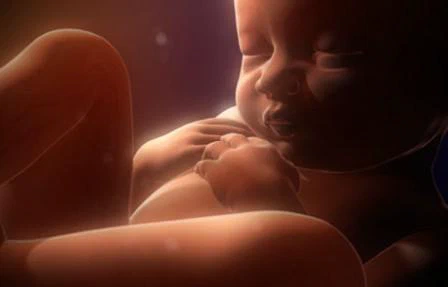
picture from National.geographic.in.the.womb

I once heard it said that somewhere in our subconscious, we can still recall the time we spent in the womb. I keep wondering — what did that warm, moist womb actually look like? And would we want to go back?

Scientific research shows (forgive my tone here…) that being born is the greatest ordeal of a person’s life. We leave behind the environment we were innately given — the womb — and must adapt to the outside world. Could we think, back then? I’m sure we must have been able to, in some fashion, or we wouldn’t have come crying into the world at all. Life itself, from the very start, is an ordeal.

Many people like to use the color blue as a metaphor for mother, because the earth is blue, and the earth carries humanity the way a mother carries her child in pregnancy. But if you trace the origin of the word for “mother” (妈妈) in Chinese, it turns out to be, under patriarchy, an insult and a contempt directed at women. The right half of the character 妈 — 马 (“horse”) — anciently referred to a chamber pot (a kind of male urinal), and woman was thereby equated with an object and instrument for discharging desire… and that is the original meaning behind the word “mother.” (Li Ao)

Thinking about my mother’s belly stirs up an extremely complicated awareness in me, one I find hard to even picture. Is it longing? Is it avoidance, or merely a kind of wishful fantasy? I really don’t know. But I think that for everyone, the womb we once existed within, inside the maternal body, is a universe in another sense entirely — one filled, at different times, with joy, with warmth, with love.

A Trip to Mount Emei

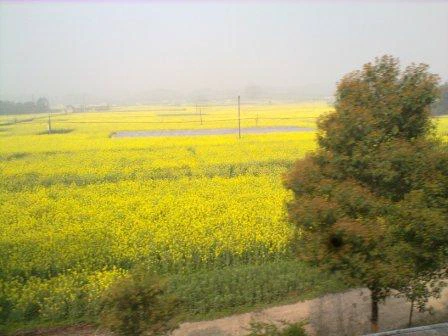
Field after field of rapeseed -- though what I really wanted to see was Qinghai Lake
Field after field of rapeseed – though what I really wanted to see was Qinghai Lake

Before going to Mount Emei I had started reading The Razor’s Edge, but had only gotten through the opening when the three-day trip began – from the somewhat idle fourth week of the semester to the “immortal mountain” of Emei, which takes 75 kilometers of climbing to reach the summit. On the train I could see field after field of rapeseed, and I found myself wondering about the meaning of this journey. It wasn’t until we reached Zhongshan and met some warm-hearted “Emei locals” that I finally understood: travel has no meaning at all – only the unexpected.

The route up the mountain we chose saved a good deal of time, but made us miss most of Emei’s scenery. The tedious mountain path made the claim of “150 li of scenery” feel rather exaggerated. After climbing one ridge and looking out into the distance, all you’d see were endless, clearly tiered stone steps. Exhausted from the heat, I slumped down by the roadside to rest, and found myself drifting into a kind of self-analysis, wondering whether the joy I’d once felt climbing steps like these had ever really been real, and whether illusions even exist.

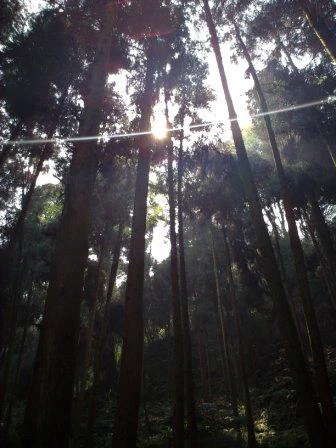
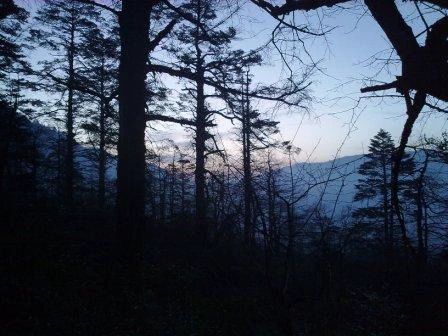
To catch the sunrise we set off climbing at 5 a.m. the next day, when the mountain was still utterly pitch black, the sky as deep as ever. Walking through it, I could clearly hear the wind trembling through the forest, and the faint cries of unseen creatures – as if all of it were trying to drive away the night travelers on the mountain path. After a while, at nearly 3,000 meters above sea level on Mount Emei, the dawn glow began spreading, level with us, slowly, into the still-sleeping forest.

Sheshen Cliff
Sheshen Cliff

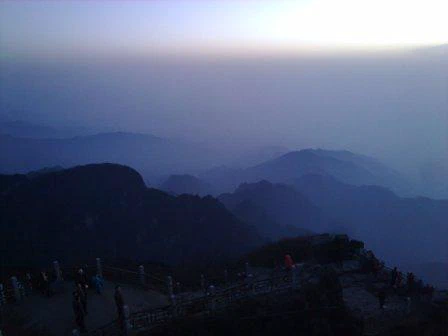
The sunrise was probably the first real Emei scenery I saw – though by then we had gone straight to the summit. When we first arrived at the Golden Summit, the sun hadn’t yet broken through the clouds, the light still dim, and the vast ranges of mountains were mostly buried in morning mist, so you couldn’t tell how magnificent they really were. All that could be seen were the mountain peaks standing erect like firm breasts – though unlike the taut, jutting feeling associated with S&M, I found it hard to put into words that particular sense of oppression. I stood there in a daze for a good while because of it.

The sun had already brightened -- not a great shot
The sun had already brightened – not a great shot

After a while, as sunrise drew near, more and more people gathered on the Golden Summit. Watching the crowd grow gradually more excited as they waited, I wondered: isn’t sunrise and sunset itself a kind of expression of eternity? Are people pursuing eternity itself, or just one of its outward appearances? The sun rose on schedule, golden light slowly breaking through the clouds, draping the earth in a hazy veil, dressing the heavy ranges of mountains in what might be called a beautiful burial shroud. The light, not yet too harsh to look at, left me entranced.

Heard afterward that the monkeys like to pee in the spring water = =

The hardship of the descent goes without saying, but more importantly, it was only then that we truly saw Emei’s landscape, only then that we understood its wonder. When thirsty along the way, we’d stop at a mountain spring for some original, unfiltered “Nongfu Spring”; when tired, we’d sit down on the steps and enjoy the shade tucked away among the cliffs. Although the endless steps left us utterly exhausted, we all felt the trip had been worth it. At the end we also treated ourselves to a soothing radon hot spring.

Oh, and at night the stars were dense and bright – was that the Big Dipper? Orion? And for the first time I saw a shooting star, gone in a real flash. I made a wish, not too big, not too small – not sure if it will come true.

Sorrow

Sorrow is a stone statue woven from countless shadows, one that doesn’t know how to love,
it needs no understanding, needs no protection.

A Brief Farewell

The pain near my neck and shoulders has lasted a month now — from using the computer too much. I’m stepping away from the computer for a while; finals are coming up, so I need to prepare properly for exams. But I still feel like there’s so much I wanted to say that I haven’t said. Ugh… I’ll come back and continue later.

People Rush About, But Toward What — Will 2010 Just Carry On?

Today is already the last day of 2009. Opening up my Google Docs, the blog text for the year has reached sixty thousand words — needless to say, I’ve produced a lot of internet garbage, piled up the past, but it also feels like returning to a few years ago, lying awake at night watching documentaries, jotting down moving moments from the African savanna, moved to tears by the humanity they portrayed. Now I’ve gone back to what people call “ethics films” (lunlipian), though watching that kind of film is actually quite uncomfortable. In high school, because of my age, there was a lot I couldn’t grasp; now it’s the opposite — still shallow, but a further analysis of people is taking place, through a method of “empathy,” though only directed at characters in films.

I say uncomfortable because it requires putting yourself in the characters’ shoes — one moment you’re a wronged wife tormented by a third party, the next a petulant, resentful young hothead, then a gay man doubting his own sexual orientation, then a family member suffering through the agony of death… Gradually, in the process of empathizing, your own emotional world gets stripped away, and you become the troubled teenager, the homosexual, the necrophiliac, the lonely old widow. Until you can no longer distinguish honor from disgrace, right from wrong — just like a “receptor,” responding to whatever command comes in, all sorts of responses, even those concerning life and death. So gradually I came to understand the helplessness and pain of a psychoanalyst — everything is so limited. At a dinner someone asked me, what exactly counts as an “ethics film”? I was momentarily speechless, and gave a hasty answer that it’s defined by the director — actually the very label “ethics film” is wrong to begin with, because what we call “ethics” is far too small next to the conflicts of emotion.

What strikes my heart the most is the thing talked about most — emptiness and bewilderment — and it sweeps in like a tidal wave. Why do people choose busyness, why do they choose loneliness — I don’t know if there’s some collective unconscious or social issue behind it. What I do understand is that emptiness and bewilderment have wedged themselves into the cracks of my busy life as a math major, like a rationalist poet running into a drifting, lonely vagrant in the midst of life — simply incompatible, foreign to one another. But the more you refuse to admit that these small emotions have taken hold of your heart, the more they really do slip away quietly like a black cat in the night, replaced once again by calculation and proof.

What troubles me most of all is still my studies. I’ve reached the tail end of these sixteen years of formal education, and I can now openly browse books like Erotic Songs Through the Ages (Liu Qi, 2005) or Twenty Lectures on Sex and Love (Li Yinhe, 2008) on the library’s second-floor book cart, without the embarrassment I felt in high school. So this year I’ve dabbled in a fair amount — sexology, literature, linguistics, religious studies, divination, psychology, philosophy… But there are two difficulties. First, it’s hard to read a book all the way through from start to finish — I always pick something up in high spirits, devour an afternoon’s worth, then put it down, and by the time I pick it up again a couple days later the enthusiasm has already faded. So every book ends up only partly read — at most a few hundred pages, at least a few dozen — not great. Second, further reading is hard — for closely related disciplines like psychology and philosophy it’s manageable, but it’s hard to juggle the rest, and once I stop, picking it back up means starting from scratch, and on top of that my disobedient eyes keep wandering off, so everything gets even harder. Ugh, ugh, ugh.

How much of the objective and subjective can the human brain really face, how many contradictions can it untangle? Faced with this fragmented world, will someone really come and deconstruct it for me? I don’t want to keep starting and stopping like this — I want to find some stability, to live it out faithfully from beginning to end, quietly, until death. I don’t know whether everything will keep going in 2010 — continuing to manage a life that never gets managed well; continuing to prove math problems that take so much effort; continuing to watch, on and off, restricted films and documentaries; and in the end, will I be able to answer the question that troubles me most: people rush about, but toward what?

Confucius said: study the old to understand the new. Since that’s so, let this piece serve as a summary of 2009 and a preface to 2010. I hope next year won’t turn out the way Twelve Monkeys (1996) put it: the future is history. But to look at it pessimistically, the present is already history.

Time

Outside it’s 9 degrees, nearly midnight
A thought of embracing has been brewing all day
It seems it will fade, growing stronger then dissolving, with the drowsiness
I really need your embrace
Gently, slowly, attentively, that would be enough

Looking at “Brother Zeng” from a Different Angle

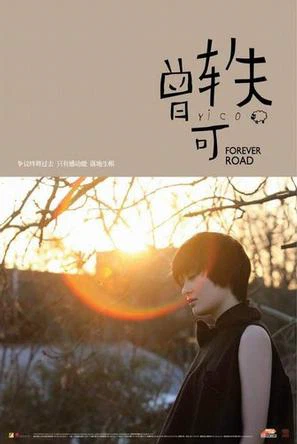
Zeng Yike's debut album, Forever Road, 12.18
Zeng Yike’s debut album, Forever Road, 12.18

A guy in our dorm got quarantined a few days ago. He’s usually always humming “Leo” under his breath, and these past few days without him have felt a little strange and uncomfortable. It got me thinking again about Zeng Yike — first of all, she’s absolutely the focal point of Happy Girl; the moment she steps onstage, both the judges on TV and the rest of us watching at home perk right up, listening with a kind of mock-seriousness to her unconventional performances.

I’ve heard a couple of her songs, and honestly they’re not nearly as bad as rumor would have it. Sure, her lyrics aren’t especially profound, her melodies aren’t exactly pleasing to the ear, her “sheep’s voice” isn’t all that clear, and she kind of looks like Stallone… but her flaws and shortcomings, paired with her talent, come together to make a Zeng Yike unlike anyone else.

The people around me keep going on about how “Brother Zeng” is this or that, and for a long time I assumed most people were against her. But a couple of days ago I checked the Baidu forums, and it turns out the number of people who support her is absolutely no less than those who support people like Zhang Liangying. Looked at from a different angle, the real question is whether everyone is championing conventional aesthetic standards, or a freer, unrestrained kind of performance.

The crux of how people judge Zeng Yike — whether judges or the public — lies right here. But thinking it through a bit more deeply: can a genuine singing performance even really be judged at all? When people set out to define it, they inevitably go by tone, technical skill, arrangement, stage presence — every one of these is a way of deconstructing the art form of performance. But if art can be deconstructed like that, then surely there wouldn’t be so many “masters,” because we could just imitate them endlessly.

Or maybe we don’t need to look at it through such an artistic lens at all — maybe Zeng Yike is simply a joke produced by a commercial age. “Brother Zeng,” “Brother Chun,” and so on have all become little cults of their own — isn’t that kind of amusing? Ha. P.S. The guy from the dorm has been let out, and “Leo” is back in rotation.

Afternoon

The afternoon sun hangs high in the sky. Everything has put on a golden coat. Warm. The cat is still curled up in the bushes, watching the people and things hurrying past. Looking for something. Paying no attention to the people rushing off to topology class. Paying no attention to the people with sore necks.

An afternoon like this should be unhurried and easy. I hate having class at this hour. It makes my hands so cold.

A Zen-Like Dream

I had a dream last night around 5 a.m. In the dream, my high school homeroom teacher kept repeating the same trivial study matters. Then a man walked in, dressed like a beggar, carrying a huge sack on his back. He went around begging from each of us; when I stepped up and asked him about it, he answered: I am you, you are me, we are doing the same thing.

I asked him again, but he just kept repeating the same line — aren’t you also carrying that many sacks? I was left speechless for a moment, then jolted awake. Words like Zen practice, enlightenment, awakening all flooded into my mind at once, and I couldn’t fall back asleep.

Once

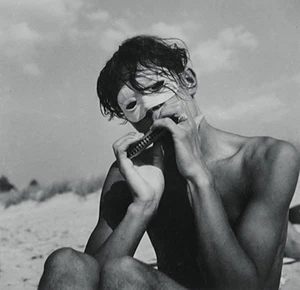
Photo/**Herbert List**
Photo/Herbert List
At last the day has come
We hold hands
Walking on the open road

The happiness settled deep
Is like a quilt at night
The scent it carries
After a day out in the sun

You and I are both afraid
Of this late-arriving, premeditated warmth
You and I both wish
That a thousand thoughts could stay still in this one moment

Starting point
Ending point

Whatever

This semester is already half over, and the assignments and coursework have gradually grown heavier and harder to make sense of. People say you need to bear the weight of pressure to truly improve, but if your body breaks down, none of that means anything. A few days of disordered living have left my stomach a little sore both when I get up early and when I stay up late, leaving me uneasy all day and stripping the taste out of whatever I eat. The most sensitive organ in my body is telling me that life has lost its rhythm a bit, and it needs to find balance again. Taking care of the inside of your own body matters more than learning more things — with swine flu running rampant these days, everyone should be careful.

College life changes a person in the smallest, most trivial ways — what time you get up each day, where you sit to study, how many books you read, how much time you spend resting — all of it is shaping, bit by bit, your attitude toward life. Though perhaps it’s only years later, once you’re working and your attitude has been compromised piece by piece, that a person can really be said to have grown up. Of course, having no experience of that myself, this is only speculation.

My attitude toward life has changed a great deal, and so has its content. To put it politely, my life has been carved away at quite a bit. Even though I’m unwilling to compromise, the time I spend blogging, watching movies, reading comics, and reading books has indeed shrunk considerably. Still piled up and waiting for me are NASA’s 50-year Earth mission, the four elements of life, The Mutants, and Still Walking, which I’ve been watching for almost a week now without finishing. The things I do in the time I carve out for myself bring me a kind of gorgeous utopia, along with a bit of precious childishness, so no matter what, I’ll keep trying to fight for that time.

The other thing that’s changed the most is the weather — winter has come early to Chengdu this year, nearly a month earlier than usual, they say, and apparently there was even light snow downtown yesterday. Too bad Sichuan University, out here in the suburbs, never got the chance to experience Chengdu’s rare snow and ice. A couple of days ago, when the cold front rolled in, there were still people in the square singing melancholy songs in high, breathy falsetto voices, with surprisingly decent skill. But whether the event ended or the weather just got too cold, they vanished as of yesterday, leaving me with an indescribable loneliness whenever I cross the square now.

Waking Into Reality

A classmate told me she doesn’t like dreaming, because it leaves you exhausted once you wake up. Maybe so. Dreams take memories that are already distant and toss them even further away, so that you reach for them with all your strength and still can’t grasp them. Those memories turn into something cloud-like and imagined, or some state that can’t be named at all, existing only in the past, and in the life experiences you cared about and treasured the most.

After a long time passes, you think you’ve finally forgotten that person, those things — she no longer appears in your life. Slowly, she becomes a name, an expression, or just a single sentence, and later still, everything disappears, even the feeling itself.

But then, one morning, you’re jolted awake by a dream, your eyes wide open, your body burning hot, your mouth opening and your hand reaching out, desperately trying to call out, to grasp something. You feel as if something has gone wrong — why did you have to wake up into the real world? Thinking back on it, you’d felt at peace, wrapped in a settled sense of happiness; that person — whom you hadn’t seen in who knows how many years — had truly, vividly come back. Details that once felt close enough to touch — her gestures, her expressions, her clothes, even the way her lips moved when she spoke — you feel a fierce desire to keep them from slipping away.

Every time you think of this, you get scared, afraid that you might have just talked loudly in your sleep and your roommates heard you. You sit up, glance around, and see them still sound asleep, snoring away — nothing happened. Even if they had heard, they wouldn’t know who she was — are you just confusing yourself? You get out of bed quickly, walk fast to the bathroom, and stare at your own bewildered, haggard face in the mirror, then splash on cold water, again and again, washing everything clean, so that nothing is left behind. That’s what you thought, and that’s what you did.

Lately I’ve been having a lot of dreams, dreaming of all sorts of strange old things — not nightmares, but exhausting all the same. No matter how late I go to sleep, I always wake up at the tail end of a dream before six. I want to live a settled, ordinary life, but I can’t manage it. I’m troubled by dreams again — I don’t want to wake into reality. This entry isn’t about anyone in particular — it only comes after the dream.

Necrophilia

I’ve always longed to hold you and sleep in your arms, to embrace your body and kiss your face

You have no heartbeat, no breath, yet I can still see your smile

Pale Green Eyeshadow

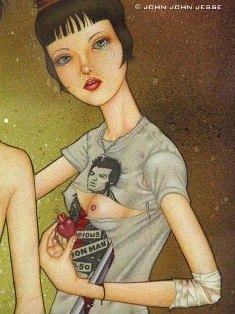
photo by john john jesse

I don’t know whether there are still stories left in this world, or how much of a “story” there is in any single real event. When you encounter a love story tangled up with death, are your tears really for the tragic beauty of the love, or for the sorrow and weight of the death? Their love was pure, without a trace of impurity, so important and so perfect in each other’s memories — is first love still like that today? I wonder whether what’s in the story is really love — the pale green eyeshadow, the single earring, the flowing long hair — and whether any of it was real.

Falling for That Airy Feeling

I’ve been coming down with a cold lately, and the sky has stayed overcast. It made me think of a photographer named Shimamoto Marisa. I’d seen her photography before, and back then I wasn’t really fond of her overexposed treatment, even though plenty of people praised the fresh, beautiful whiteness in her work. I listened indifferently, thinking that this kind of light couldn’t possibly produce whatever people called an “airy feeling.” Thinking about it now, the heaviness I felt at the time made me overlook the beauty in those photos. Let me put up a few pictures — if you google this photographer, most of what you’ll find looks like this. A lazy cat dozing in the afternoon sun; a blue sky with sparse white clouds drifting by; the smell of beach and seawater, watching the waves catch and flash with light. I’ve fallen for this kind of treatment, letting sunlight spread over everything, and that feeling… what’s called the “airy feeling” turns out to be sunlight plus air plus water. The more I look, the more I feel how beautiful life can be, and the paleness of time seems to disappear.

Life, a Comma

In a piece of writing, every comma is a pause, a sign that the text isn’t over yet
After the comma is an unknown riddle, leaving you curious and eager to explore
Especially after the heart-pounding drama of the first half of a sentence, we look forward even more to seeing how the latter half resolves
A comma is a strange and ordinary spiral, leaving you unable to see clearly, unable to grasp it
Life itself is a comma, brimming with infinite possibility
Even this morning, you had no idea what the afternoon would bring
The only thing you can do is steady your spirit and face the unknown challenges and variables
Gather your energy, let your boiling blood surge, and watch closely — remember this after every comma in life

God’s Dice

I happened to come across a theorem called Gödel’s theorem, which roughly states this: in a complete theoretical system (one in which every theorem can be proven true), there must exist a proposition P and a proposition not-P (on the premise that P and not-P must be one true and one false). In other words, in any theoretical system there must exist propositions that can be proven neither true nor false — meaning all theoretical systems are incomplete. At first I thought it was some “expert” daydreaming in a vacuum, dressing up his own nonsense in professional language to pass it off as a theorem. Later I learned this theorem is actually a mathematical one, and a proven one at that (I still find this hard to believe — apparently if you’ve studied mathematical logic you’d just get it)! And it once overturned Hilbert’s philosophy of mathematics. Thinking it over carefully, this theorem tells us not just its own content, but also that humans can never fully comprehend this world. There’s another theorem that gives me a similar feeling — the uncertainty principle — which likewise hints that people can never fully grasp the entire universe.

These past few days I keep thinking of something Joseph Ford once said: God and the whole universe play dice, but the dice have been tampered with. Humanity will never know all the laws of nature — if humans ever did know all the laws, humanity would go extinct, because at that point people would try to change those laws, and the only result of changing them would be extinction. P.S. This reminds me of a blog post by Hua-something that was similar to this one — its last line captured perfectly the strange wonder between humans and the world. I looked at it again carefully today, and it seems the uncertainty principle doesn’t actually say that all particles can’t be measured.

A Report on Life

I really wish feelings could follow simpler logic
Even when you mean to throw your words out gently, sometimes they still turn into hurt
At the very least, what happened today was unpleasant
In the days ahead I need to learn to cherish
Cherish the people I love and the people who love me
Never hurt them — never, ever

For the things you want, you should chase them with everything your life has
For the things you’ve gained, you should tend them with every bit of your heart
May everyone cherish the people who appear in their lives
Send them a blessing from the bottom of your heart
Sometimes something simple is already enough

I should be a decisive, exacting director
Shouting “cut” loudly at the eight or nine times out of ten life goes wrong
Or be a willful, unruly drifter
Shouting “fuck it” at the crowd whenever I’m unhappy
But in the end these are nothing but shouting into the void
After the shouting fades, the mood and the life still have to be slowly cleaned up
My wish is simple
To keep some tension alive even within the plainness
Is a life like that really impossible?
Everything still has to move slowly
As slow as a lover’s gentle hand plucking a flower
As slow as moonlight and cherry blossoms drifting down in the night

It’s getting colder
Today when I got up, breakfast was already gone
My hands and feet were cold too
And then something else came along to make me unhappy
State of mind really does affect the body
Learning to face things calmly is what I need most
Mixing a cup of oatmeal, sitting at the computer, chatting about nothing in the group
I don’t know how to respond to everyone’s comfort
Like an uncivilized child listening to a lecture
But at least there are things I’ve finally come to understand
Writing this entry to record whatever feelings I can still capture
Hoping life won’t depreciate like a stock

Watching the steam rise off the oatmeal like thick ink, my heart actually warmed
And so, there is hope after all