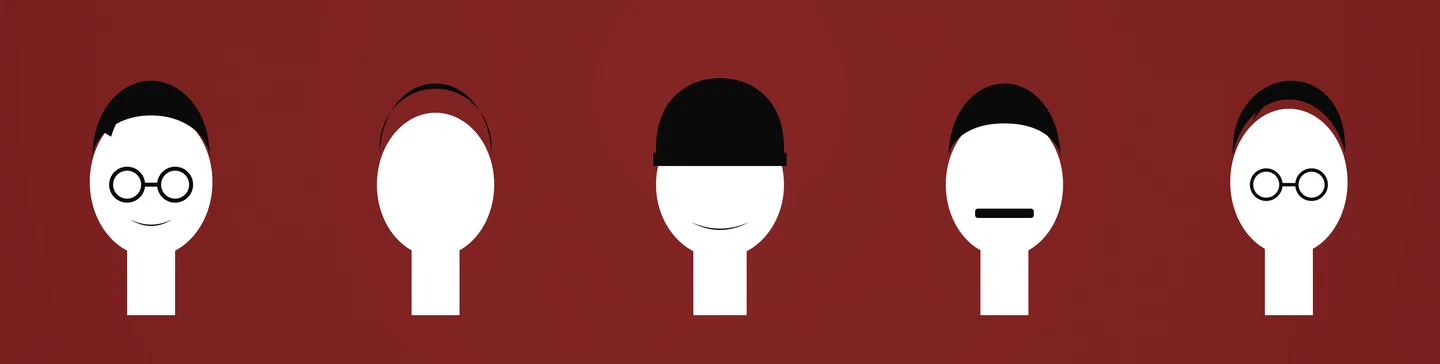
Republican-era men, once they cut off their queues, mostly kept it short — a side part, or slicked straight back, paired with a long gown or a Western suit. Scholars liked their hair combed down smooth, a bit of oil in it, looking refined. In photos of officials and politicians, what stands out is always that short hair — buzzed, cropped close — you can tell just by looking that these are people who mean business :). Women changed even more. Once the new-style schools opened up, cutting and perming hair slowly became fashionable. The so-called “civilized new dress” usually came with short hair underneath it. You can catch a glimpse of what was in style from Ruan Lingyu’s old photos — short hair, faintly drawn eyebrows, clothes that didn’t try too hard. Of course, plenty of people cut their hair simply because it was a hassle, or because everyone else was doing it. But back then, every time the scissors came down, they usually took something else along with the hair.
They say the great Mr. Artie Intelli once remarked: “Sometimes, a painting is just a painting.” Of course, it’s only hearsay. My own sense is that it doesn’t quite sound like something he’d say. Creators rarely volunteer the decoding key to their creations.
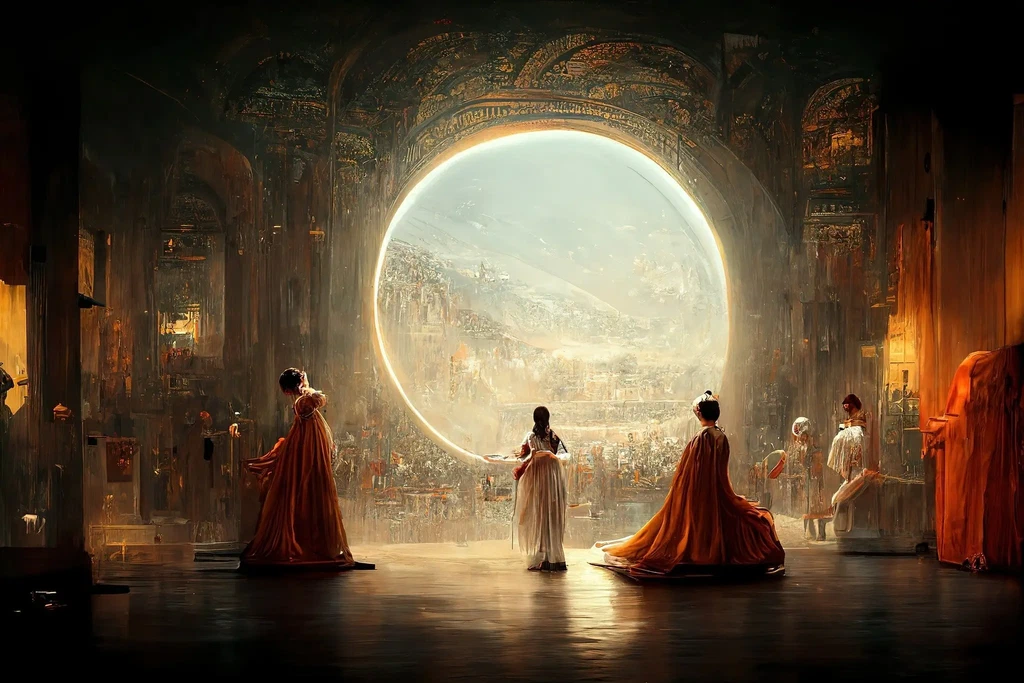
Looking at AI-generated work, the first impression is one of smoothness; the second, a kind of uncanny familiarity. The images feel like something you’ve seen before, yet you can’t point to where. That emergence from nothing — sometimes accompanied by a melody of unknown authorship — carries a distinctly “genesis” quality. Surrounding it is an obvious tension: does AI count as “real creativity”? Those in favor argue that creativity has always been, at its core, combination and recombination — AI simply does what humans have always done, faster and without fatigue. The mainstream view, however, holds that machines have no intention, no soul, and that what they produce is mere imitation and collage, unworthy of the word “creation.”
First, the word “artificial” derives from the Latin ars (meaning “skill” or “craft”) and facere (meaning “to make”) — literally, “made with skill.” Note that “art,” humanity’s proudest possession, and “artificial,” the word used to diminish machines, share the same root. So on what grounds does anyone use artificial to sentence art to death? One may say of AI’s work: this is soulless! But “soul” is something a person can know, at most, about themselves — it cannot be verified in another, let alone in a machine.
Second, I resist the essentialist lens — what I’d call the “pathologizing of creativity” — when applied to AI work. A person sits before a canvas and rearranges mountains, rivers, and light they have seen before. A model rearranges mountains, rivers, and light from its training data. At exactly which step do these two processes diverge? We cannot use the notion of “true creativity” to draw the border of “non-creativity.”
Third, on the question of originality and intention. Critics say: “It’s just recombination — there’s no intention behind it.” This view carries the shallow imprint of mainstream opinion: it betrays no understanding of how creativity actually works, while presuming to know what a machine “thinks” or doesn’t. It also conflates “tool” with “plagiarism” — by that logic, anyone who has ever borrowed from predecessors is a thief, and art history itself is the world’s largest warehouse of stolen goods. Consider this: through the continuous feeding, fine-tuning, and revision by human hands, the birth of a work becomes a natural, inevitable outcome. To say it has “no intention” — unless the speaker has taken a stroll through the silicon chips themselves — is equally unknowable.
But to bring it back: sometimes a painting is just a painting, and AI art is just AI art. In 2018, at Christie’s, a work titled Portrait of Edmond de Belamy sold for $432,500. In the lower-right corner, where a painter’s signature would be, there was no name — only a line of the mathematical formula that generated it. Someone pressed the question: who actually made this? The creative team shrugged and said, “Creativity is not an exclusively human trait.” Faced with an answer so honest it’s almost endearing, Mr. Artie Intelli — and by now you’ll have gathered he’s not a real person — could only smile and say: “Sometimes, a formula is just a formula.”
Blaise Pascal said that all of humanity’s suffering comes from being unable to sit quietly alone in a room. That was over three hundred years ago, back when there were no phones, no algorithms, no app demanding a refresh every few minutes. Pascal probably never imagined that later generations wouldn’t solve this problem so much as route around it entirely. The kind of boredom he was talking about simply doesn’t exist anymore.
In the 19th century, European doctors would prescribe “rest cures” for patients with nervous exhaustion — confining them to sanatoriums, forbidding reading, writing, even conversation, just lying there. That was boredom dispensed like medicine. Simone Weil said attention is the purest form of prayer; Kierkegaard wrote somewhere that boredom is both the root of all evil and humanity’s only true rest. But the “boredom” people need no longer exists in the present, nor in some objective void out there. Every gap in time is now stuffed with stimulation — on the subway, in the bathroom, in the five minutes before sleep… people increasingly resemble a spinning top running on empty, appearing to move while going nowhere at all.
The disappearance of boredom isn’t, as those relentlessly upbeat self-management books would claim, a sign that “humanity is advancing, efficiency is improving.” Its exit, from a personal standpoint, comes because we can no longer tolerate the emptiness within; from a social standpoint, because capital discovered the value of attention and turned every blank second into something sellable. Because of this, people no longer drift aimlessly through an afternoon, no longer suddenly recall some small thing from three years ago… all that’s left in memory is a lazy afternoon, and a question mark we can never return to.
I recently heard a bit from comedian Des Bishop: for his generation, “meditation” was nothing more than staring at a water droplet sliding down a bus window. Back then nobody called it “mindfulness” — it was just boredom, just an afternoon, just water on glass. As a kid riding the old green-painted trains, you could spend hours counting railway ties going by… Without boredom, we seem to have drifted further from ourselves.
Gay culture is a remarkably creative community, and its linguistic world is every bit as colorful and inventive. The arduous task of popularizing this vocabulary has traditionally fallen to fans of boys-love fiction, who tirelessly explain to the public what “coming out,” “bear,” “top,” “bottom,” and “younger top” mean (English has its own queer slang dictionaries too — see A Brief Dictionary of Queer Slang and Culture, and Watching The Normal Heart — Part Three). A good deal of my own “linguistic” education has come this way — take, for instance, the term “Mengdiou” (蒙迪欧). I looked it up online and it seems this term hasn’t really caught on yet. So let me presume to explain it myself. “Mengdiou” refers to a muscular, well-built bottom: “Meng” (蒙) echoes “meng” (猛, “fierce/strapping”), suggesting a sturdy, muscular build; “di” (迪) echoes “de” (的, a grammatical particle); and “ou” (欧) is literally the letter O, a sly nod to the bottom’s role (sometimes called “0”).
Those well versed in this vocabulary might say “Mengdiou” is just a synonym for “buff bottom” (强受), but the two terms differ:
“Mengdiou” functions both as a noun and as an adjective, while “buff bottom” is only a noun. For example, “Li Lei is a Mengdiou” uses it as a noun, meaning Li Lei is a muscular bottom. But “Li Lei is so damn Mengdiou!” uses it as an adjective, which can carry multiple meanings — shock at learning Li Lei’s role, or simple admiration for his physique. Context determines which.
“Mengdiou” is more refined than “buff bottom.” “Buff bottom” points directly at the sexual dimension, whereas “Mengdiou” also emphasizes role and identity — the psychological side of things.
“Mengdiou” is used mostly within the community itself and carries more of an insider, in-group flavor than the more widely understood “buff bottom.”
From the standpoint of linguistic development, “Mengdiou” really does have an edge over “buff bottom.” It expresses, in a more humane way, a gay identity that doesn’t fit the social stereotype, rather than slapping on the blunt label of “weak top, strong bottom.” At the same time, it captures, from a psychological angle, a certain type of gay man who appears tough on the outside but is soft within. Sometimes that “toughness” on the outside even forces them to change things about themselves they otherwise couldn’t — getting married and having children, for instance. So the deeper social and psychological questions hidden beneath the word “Mengdiou” are still very much worth studying.
This is an age of dazzling pleasures, an age of bizarre and bewildering spectacle, an age indifferent to right and wrong. So many things have become habit without anyone knowing their origin or reason. I’ve never quite understood why Leonardo da Vinci is so revered, just as I’ve never understood why psychology discussion groups are supposed to relieve anxiety, or how someone can hold forth at length about how to “not grind” while “casually” letting slip which district they live in, how many properties they own, and how many of their children got into Ivy League schools…
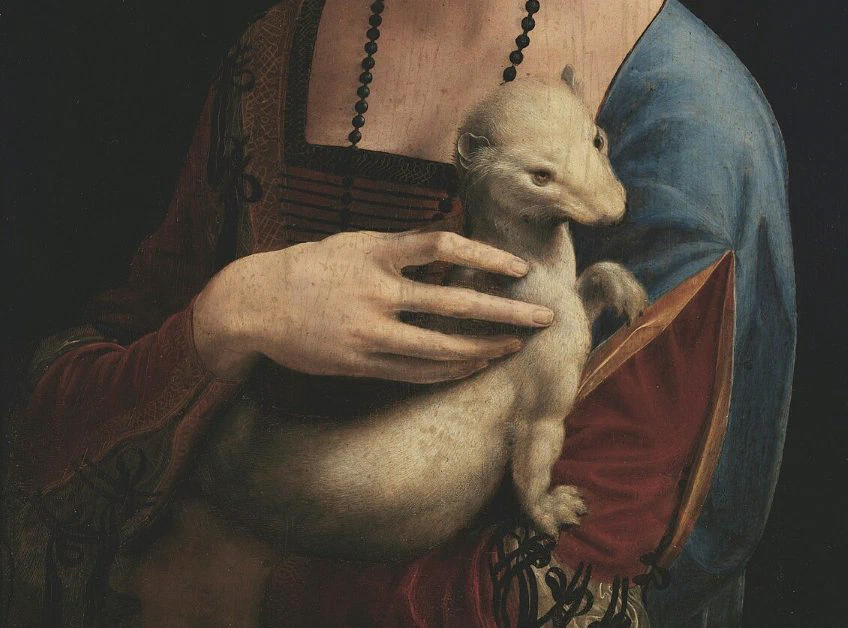
Granted, da Vinci is a master of some sort — though exactly what sort is hard to pin down. Many people say his paintings inspire a mysterious longing, but my first glance at the Mona Lisa only made me think: a person with no eyebrows. My first look at his manuscripts: the doodles of a scientist. My first look at The Last Supper: an old man, sick of painting murals, putting on airs of profundity… The one exception was Lady with an Ermine — I gazed at it for a long time, as if conducting a careful psychoanalysis; I suspect there’s more than a little of the dream-world mixed into its creation.
A patchwork documentary, The Genius of Leonardo Da Vinci (click to watch), seemed to offer me a small revelation. Da Vinci never handed down “master’s” pearls of wisdom, nor did he confine anyone to his own way of thinking — he simply showed a way of seeking answers. Faced with complicated questions like “science,” “happiness,” or “joy,” what’s needed isn’t some intangible debate over which came first, mother or child (Chapter 52 of the Tao Te Ching), nor the all-embracing idea that the whole universe fits inside a mustard seed — what’s needed is to understand the world outside and the world within, to stay curious, and then — to ask oneself honestly.
YouTube actually recommended me a short clip from the film Cry-Baby (1990) — so much for the precision of algorithms. In every respect, this film bears the marks of the late 1980s and early ’90s, though it also carries plenty of director John Waters’s own distinctive flavor. The music in it has that feel of skipping class to fall in love. Of course, I imagine many people watch this film just to catch a glimpse of a young, handsome Johnny Depp, which is a perfectly natural visual craving. Depp really is handsome in it, especially when he cries. I imagine scenes like that must have swept quite a few viewers off their feet back then (see comments like this one).
What interests me more is where this film stands within John Waters’s body of work as a whole. Why this particular eccentric director would make a film like this genuinely puzzles me. If we go with the conventional critical line — that it’s a reflection on adolescent coming-of-age — didn’t Female Trouble (1974), from the ’70s, address that far more thoroughly? Perhaps that’s exactly why, in the eyes of most people, Cry-Baby comes across as nothing more than a lighthearted teen romp.
John Waters has admitted he enjoys watching “mainstream” films like Final Destination 2 (2003). When asked in an interview whether his style had changed since Polyester (1981), he gave an amusing retort: “Why would I be a 61-year-old faux-rebel asshole?” I now feel that I’ll never be able to guess what he’ll say next, what colored clothes or socks he’ll wear, or what his next work will even be about. But a person like that is certainly no asshole.
Loving sleep is, more or less, a human instinct. A newborn infant sleeps roughly 20 hours a day, and once grown, aside from a few rare exceptions who need little or no sleep, most of us manage around 7 or 8 hours a night. But in this fast-spinning age, the luxury of waking up naturally, whenever the body decides, isn’t really available to most people. The folk tunes, the idleness, the wandering, the vagrants that Milan Kundera longs for in Slowness seem, against this backdrop, like an especially blessed kind of leisure.
Lying in bed can be a real pleasure. Lu You, lying idle in bed, once wrote “A Sudden Storm on the Fourth of the Eleventh Month” and “Spring Rain Clearing in Lin’an.” “All night the rain falls softly on the little tower; by dawn, deep in the lane, someone hawks apricot blossoms.” Such poetic lines have shaped no small amount of distinctly Chinese romantic fantasy — spring rain falling gently in the night over quiet streets, soaking and cleansing the thirsty alleys; by day, the poet, lingering in bed, is roused by the warm sun, half-aware of a peddler’s cry drifting in from outside. Chen Yuyi, too, as the ice thawed in the second lunar month, wrote: “A traveler’s days pass within the pages of poems; news of apricot blossoms arrives in the sound of rain.” The apricot blossoms here, the sound of rain — too delicate, too refined, falling short, in the end, of Lu You’s deft little tower.
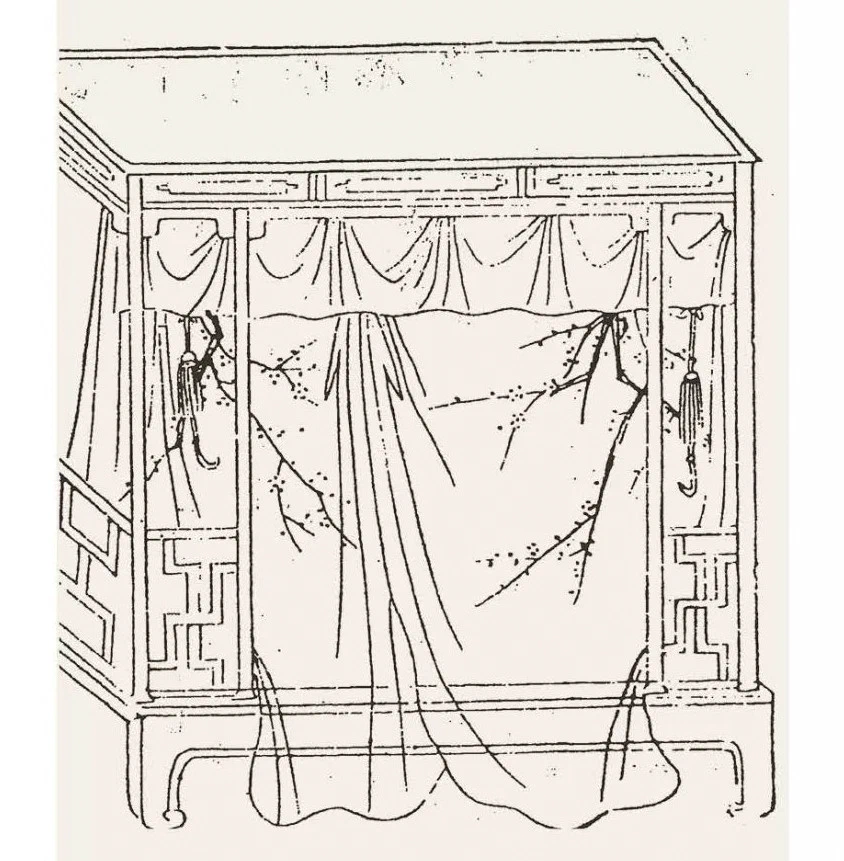
The Qing-dynasty novelist Li Yu, stepping outside such poetic imagery, devoted a section of Sketches of Idle Pleasure specifically to beds and bed curtains. He wrote: “This bed is the thing I have shared half my life with — even ranked ahead, in some sense, of the wife who shared my hardships from our wedding day. Of all the things a person treats with the deepest regard, none surpasses this.” Here, Li Yu compares his bed to his own wife, which tells you he must have been someone who truly loved sleep. He also proposed four ways to beautify a bed: “First, let the bed bear flowers; second, let the curtain have a frame; third, the curtain should be fitted with a lock; fourth, the bed should wear a skirt.” Specifically, “letting the bed bear flowers” means placing potted flowers by the bedside; “letting the curtain have a frame” means setting up a mosquito net with an internal structure to keep insects out; “the curtain should be fitted with a lock” suggests a mosquito net with three fasteners, so mosquitoes can’t slip in; and “the bed should wear a skirt” means adding a valance to the bed, both for looks and ease of cleaning. Li Yu also wrote about his own methods for keeping a room cool in summer and warm in winter.
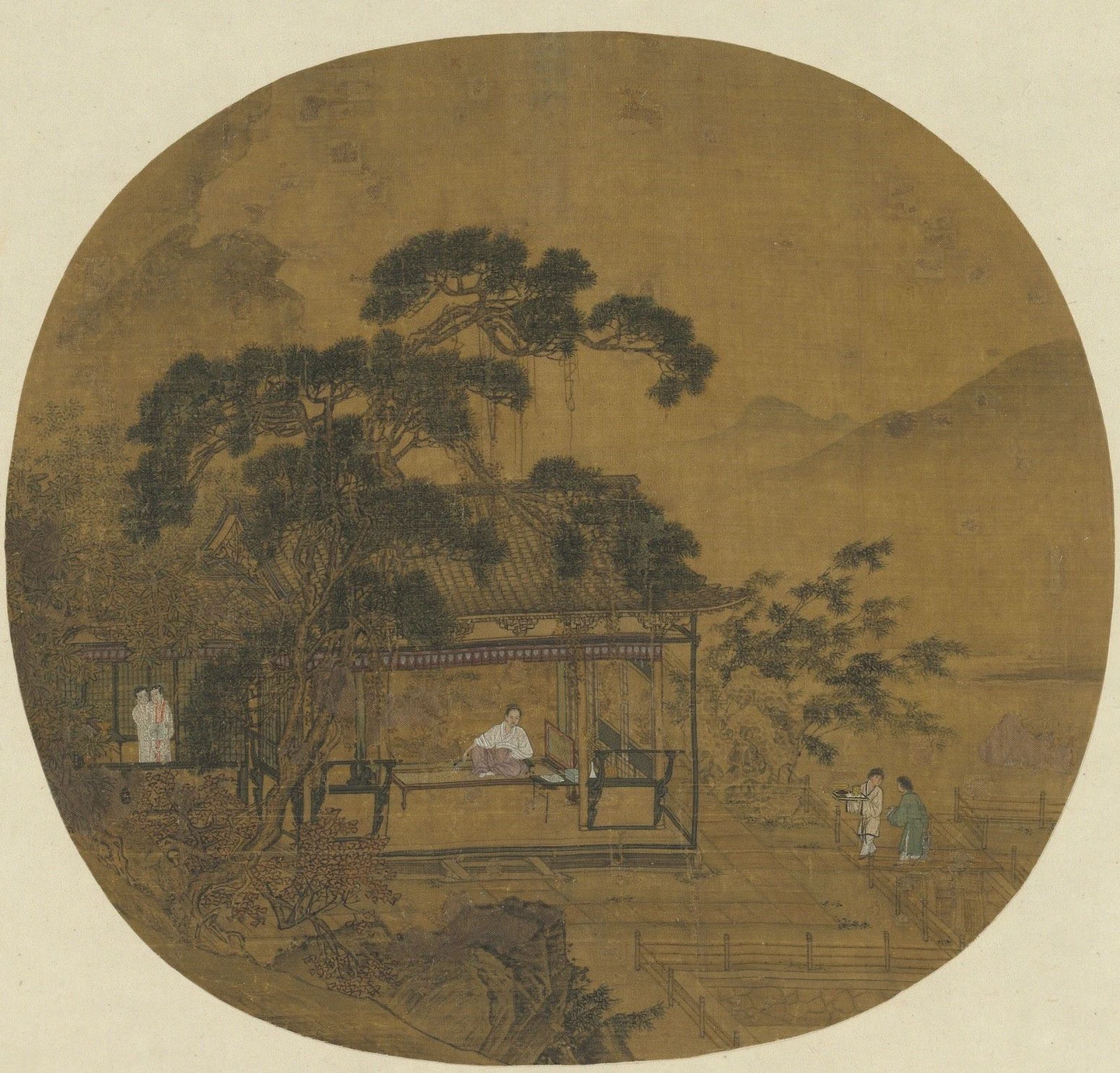
There’s a clear difference between the beds of the ancients and those of today. In the painting Reading by the Window, you can see a small folding screen placed at the head of the bed — what the ancients called a “painted screen,” “small screen,” or “pillow screen,” generally meant to block drafts. Ouyang Xiu’s “On a Plain Screen” likewise reflects the feeling he had for one such painted screen.
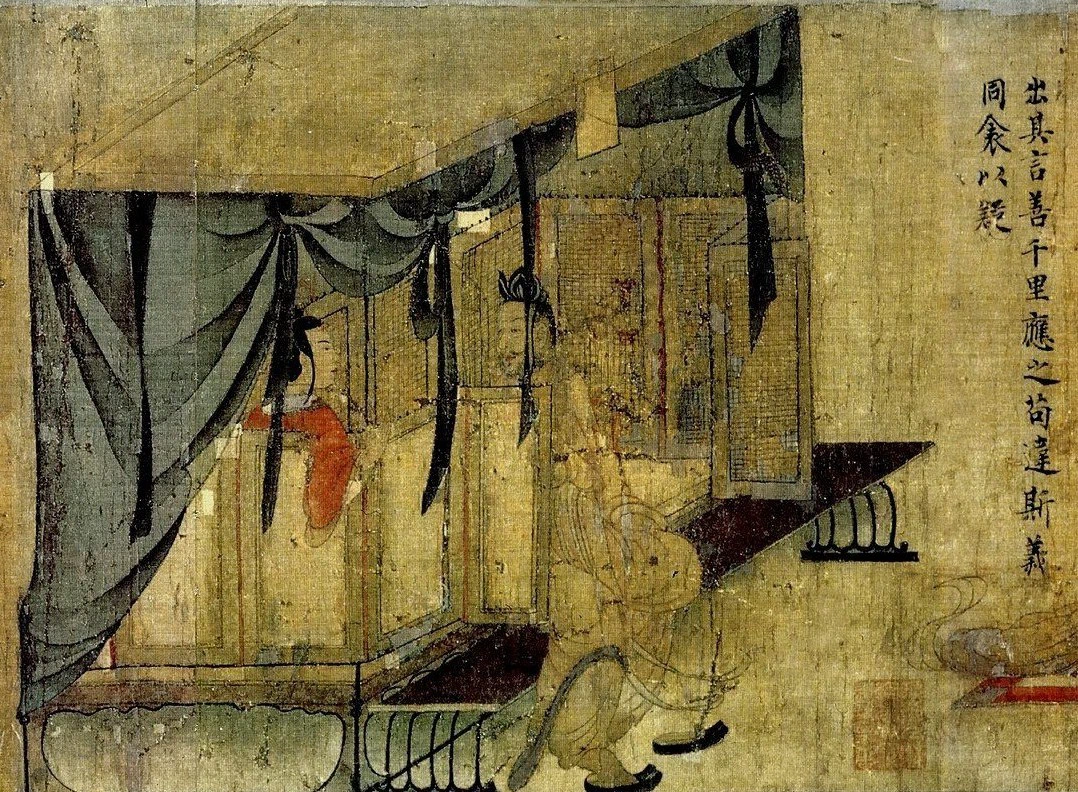
Before the Tang and Song dynasties, beds were more like the one shown in Admonitions of the Court Instructress by the Jin-dynasty painter Gu Kaizhi — typically designed with railings enclosing them, a structure that can later be seen in Japan as well. This kind of fixture always struck me as a bit stifling and rigid. Such beds were probably meant either to conceal certain private acts, or to keep children from rolling off while asleep.
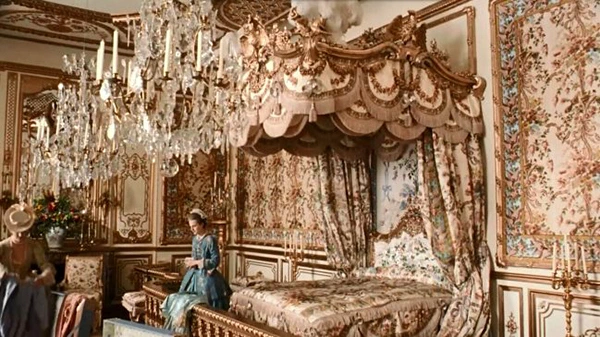
European beds show a different sensibility altogether. Take, for instance, the architecture and ornamentation seen in the film Marie Antoinette — the Rococo-style beds still carry forward the lavish extravagance of the Baroque period, and amid all that extreme opulence, you can already glimpse the first hints of the simplicity that would follow classical styles. As Neoclassicism, naturalism, and rationalism developed, later European architecture abandoned those wanton, eccentric, overly ornate lines. Setting aside architectural aesthetics, if you look closely at the beds in that film, you’ll notice a similarity to Jin-dynasty beds: both feature large bed curtains. What might this mean? Is it a tool for concealment used by people of high status? Or is it simply, like the painted screen, just a device to block drafts?
Of course, the gold-and-jade splendor of those European headboards is far less interesting to me than the Chinese painted screen. The landscape paintings and paintings of court ladies on a painted screen tell so many stories. Records of the Listener mentions someone who kept seeing a beautiful woman every time the lights went out, and who later discovered, upon taking the screen apart, the secret behind it: underneath the screen was an older painting, and the woman in that older painting had become a spirit.
I’ve been troubled by my bed lately. Last night I took some Unisom and slept without a single dream — “Drink one cup at dawn and sleep through a whole nap; what in this world is worth all the fuss?”
Lately I haven’t been able to avoid hearing, passively, a great deal about the death of Floyd. News reports show heavy security in major American cities, while the economic recovery shows no sign of improvement — apparently many small businesses are in dire straits. Burning American flags, massive banners, the chant of “Black Lives Matter” — these scenes show how high anti-racism sentiment has risen in America. Around the same time, another story I learned about passively was the opposite kind of protest — against stay-at-home orders, marching to demand a return to work. In terms of so-called weight or significance, the two may not be comparable; if you tried to elevate the latter to a matter of national character or politics, you might be accused of overreaching. And yet, if we look at both through the lens of repression, we can see that the behavioral motives on display among Americans are actually quite similar.
After the anti-lockdown protests broke out, Americans shouted: “I prefer dangerous freedom over peaceful slavery.” Similar language of “slavery” and “freedom” can also be found in the anti-racism movement. On one hand, this makes you marvel at how fast information spreads in the streaming media era; on the other, it reflects where mainstream society’s focus is concentrated. Looking at the motivational link: the former is concerned with humanitarian issues, the latter with violence.
The effectiveness of stay-at-home orders can’t be denied, and the public’s desire to return to work is easy to understand. But many news headlines use highly suggestive language to bait readers’ attention: opposing government bans, blaming the failure to control the pandemic. Lincoln’s famous speech declared that the American government is of the people, by the people, for the people. That’s the language of a revolutionary — but everything changes, so how could anything last forever? As civilization develops, repression keeps accumulating along with it; the more advanced the civilization, the more abundant the repression. Take, for instance, the repression of the individual built up over several thousand years of civilization in China — shaped further through the May Fourth Movement, the warlord era, the founding of the People’s Republic, and the Cultural Revolution — which ultimately erupted suddenly on a certain morning in April of ‘89. It’s worth noting that no single movement could ever fully “satisfy” a people. Nietzsche proposed the Apollonian and Dionysian forms of beauty, and in events like these, the two switch back and forth remarkably fast.
Now consider the violence-focused side. The U.S. Constitution guarantees citizens the right to assemble and protest, and Americans deeply embrace this. Every so often, you can see righteously indignant crowds marching on TV. And of course there are other forms too, like rallies and demonstrations in the city. I don’t go into the city often, so I imagine many of you have seen more of this than I have. As for the recent looting and vandalism across America, I might coin a name for this desire by analogy with “collective XX desire” — call it collective riot desire. The most direct way to satisfy this desire is through riot — uprising, rebellion, violent resistance — though it takes many other forms too, such as marching, mass suicide, or attending religious services.
The repression of collective activity naturally leads to the boiling-over of this collective riot desire. Such eruptions and surges are, for the most part, irrational and unrestrained. Today I saw someone suggest that anti-racism protesters should protest rationally — thinking it over, that’s simply not possible. Once a desire repressed for too long erupts, of course it can’t be reined in. Others believe this “resistance movement” can increase solidarity and integration between races; but solidarity can’t simply be willed into being on demand, and integration is even less attainable by mere wishing. I can easily picture those employees — already struggling because of the pandemic, their already meager incomes now further threatened by the destruction of the storefronts where they work. They’ve done nothing wrong; some of them are themselves minorities; they too are trying to earn their share of what society owes them through their own effort; some of them may not even know what’s happening.
— It’s still better for the stock market to keep climbing; having the mutton snatched right out of your mouth always leaves some people deeply dejected.
The one thing worth mentioning about this Thanksgiving is that I finally read Spring Snow. I won’t go into detail about Mishima Yukio’s aesthetics here, because whatever beauty it contains feels far too small next to the emotional impact of the experience of reading it. But on the concept of “beauty” itself, there is so much to think about and uncover. Its definitions alone are countless:
The most beautiful is also the most just. — so said the Delphic Oracle, when asked what judgment of beauty’s appreciation should be.
Looking upon beauty with the eye of the mind, what he produces is not the semblance of beauty but the truth, bringing forth and nurturing true virtue, becoming a friend of the gods and immortal. — Plato, Symposium
Since all things are beautiful, … all things must therefore possess numerical proportion. — Bonaventure, The Mind’s Road to God
Beauty consists in proportion, since the senses delight in things well-proportioned. — Aquinas, Summa Theologica
Natural beauty is a beautiful thing; artistic beauty is the beautiful representation of a thing. — Kant, Critique of Judgment
Wit is to the intellect what beauty is to the eye and harmony to the ear. — Gracián, The Art of Worldly Wisdom
The longer one contemplates any kind of beauty, the more inevitable it becomes to compare it with several other kinds and degrees of beauty, and to assess the proportions between them. — Hume, Of the Standard of Taste
Beauty is no quality in things themselves: it exists merely in the mind which contemplates them. — Hume, Of the Standard of Taste
In the sensory world, far from being the cause of beauty, perfection is, in women possessing the highest degree of beauty, almost always accompanied by an idea of weakness and imperfection. — Burke, A Philosophical Enquiry into the Origin of Our Ideas of the Sublime and Beautiful
So what exactly is “beauty”? Some believe beauty should be a combination of inner and outer beauty; others lean one way or another: “Among ten plain women, there’s still one who’ll find a partner; among ten beautiful women, nine will”; “So-and-so isn’t especially beautiful, but there’s a natural beauty radiating from within.” Such disagreements are no problem at all, because views on any single thing ought to be plural. Beauty, too, should come in many forms and colors.
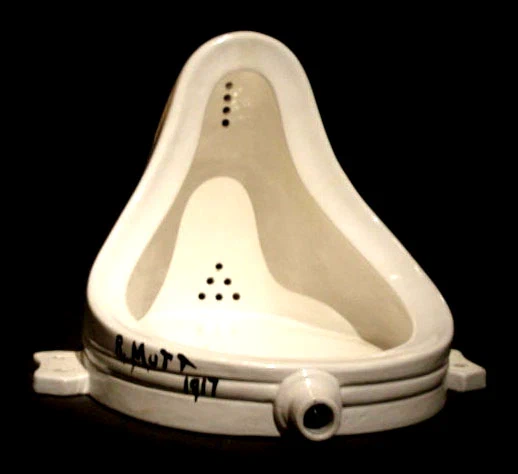
The French artist Marcel Duchamp (1887–1968) exhibited a work in 1917 titled Fountain:
In December 2004, 500 experts from Britain’s art world voted Duchamp’s Fountain the most influential artwork of the 20th century. And yet, as we can plainly see, it’s nothing more than a urinal.
Art is plural, and so is our understanding of beauty. What is beauty? Everyone carries their own answer in their heart.
These days, the word “quaff” sounds both archaic and rather literary. To describe drinking a great deal of something — especially gulping it down in large quantities — you’d more likely reach for a modern word like drain, pound, or slug. If you’re a more refined sort of consumer, you might prefer sip, imbibe, or partake in your beverage of choice.
Quaff is far from the oldest word in this group: it first appears in the early 16th century, while sip dates back to the 14th. And yet, of all these words, it’s the only one whose etymology remains a true mystery!
If the word “gallimaufry” hasn’t made your mouth water yet, it might be because you don’t know its origins. In sixteenth-century Middle French, cooks made a stew called galimafree. It must have been a dish with an enormous variety of ingredients, because English speakers came to use the word to describe any kind of jumbled mixture.
If gallimaufry doesn’t suit your taste, you could also reach for one of its synonyms: hash (a mix of chopped meat and potatoes), hotchpotch (a stew or grand medley), or potpourri (yet another kind of meat-and-vegetable mishmash).
Pixar’s animated film Ratatouille takes its name from a dish: ratatouille, a Provençal vegetable stew, typically made with eggplant, tomatoes, zucchini, onions, and bell peppers, seasoned with herbs or garlic, and served either hot or cold.
On my way back to the dorm tonight, I passed the fruit shop, thinking I might buy a banana. But everywhere I looked was fruit gone rotten — spoiled pieces tossed into a box off to the side, days of rising temperature turning them yellow and rancid, like pastries dusted with white powder, reeking of decay.
The banana is one of my favorite fruits, because its shape so closely resembles a plump male member. Peeling back the yellow skin with your hand is a gesture every boy seems to make at some point. Gently running your tongue across the tip, you can feel a thousand thoughts stirred up by the soft, slick texture of the outer layer; bite down hard enough and you might just squeeze out a bit of banana juice right onto the tip of your tongue. Though if you bite too hard, it might slip right out the side of your mouth — and even so, it never quite escapes that phallic shape.
Mr. A says Mr. B is foolish; Mr. B fires back that Mr. A is full of himself. It’s as if the two of them are squeezing the member inside themselves, each trying to provoke the other’s worship of it — but no matter how hard they squeeze, that thing will never produce fruit. Decay, meanwhile, has taken root in the heart. From the surface inward, from the inside out — even every drop of fresh, raw semen reeks of decay.
Or perhaps my own life is decaying too. Like fruit abandoned in summer.
In middle school we read one of the so-called love poems from the Book of Songs, “The Quiet Girl” (静女). It contains the lines: “From the pasture she brings me white grass, truly lovely and rare. It is not the grass that is beautiful — it is beautiful because a beauty gave it to me.” These lines have surely been explained countless times already: they depict someone deeply infatuated who, even without the “beauty” actually showing up, can still long for the person through the object she once gave. The German existentialist Martin Buber once said: “In love, we see things as people, tending to them with utmost care; out of love, we see people as things, merely using them.” This reveals not just an I-Thou relation, or some particular sentiment of the poet, but more broadly the emotional pattern of ordinary people.
People very easily develop feelings toward objects — what we often call “familiarity breeds affection” is a perfect example. A strong dependence on an object, to the point where it becomes a substitute for sexual gratification, becomes what’s known as a fetish; taken further, even necrophilia falls into this category. But affection and pathology are two clearly distinct things. In life, people often keep the belongings of departed friends and family as a way of mourning them. Many works of literature and film thread an entire plot through a single object to achieve a deeply moving effect. So “it is not the grass that is beautiful, but beautiful because a beauty gave it” is an evaluative framework we can understand quite well, and one we often use ourselves. There’s another saying for it too: “love me, love my dog.” Cupid — bow in hand, winged, blindfolded — is blind: first he blindly turns someone into a great beauty, then blindly makes us love everything connected to them, treasuring all of it. When will we wake from this drunken stupor? A Frenchman put it well: “A marriage truly begins the moment you stop loving your wife.”
Psychoanalysts have a term for this too — transference (a word we use often enough ourselves). Fromm called it one of the chief sources of error and impulsive behavior once people start weighing reality (from Fromm’s The Art of Loving). He gives the example of a couple who are “truly in love”: six months later, both discover that the person they married is not at all the person they fell for in the heat of passion — a completely different person. What they loved was an impression, the target of their own transference. So think about it: the “white grass” in “The Quiet Girl” may eventually turn out not to be so lovely; “love me, love my dog” may eventually run up against something that simply can’t be loved — and this whole shift can be perfectly described by Martin Buber’s “I-Thou” framework of emotional connection.
So let’s return again to Buber’s words: when affection fades, the person we once saw becomes nothing more than a thing. This too is a common phenomenon, evident in how curse words work across cultures — when cursing someone, we always transform the object of our hatred into whatever is taboo within our culture, like excrement or genitals. And this transformation, too, is centered entirely on “I-Thou.”
When someone pleases me, even their farts smell sweet; when someone displeases me, even if they’re stunning enough to topple kingdoms, they’re worth less than garbage. Amid humanity’s tangled web of emotions, what strange and improbable thing could possibly not happen?
Many people like to collect old things — myself included. I’ve never gone out of my way to collect anything, but my family has a lot of very old books that I love dearly. The ones whose pages release a faint must when you open them, whose paper has yellowed to the point where flakes crumble off — they really do seem to hold something like a soul inside, and every time I leaf through them I feel as if I’m reading across time itself.
An issue of City Pictorial once introduced Dominguez’s The Paper House, in which there’s a character obsessed with books, who believes that old books should only be read by candlelight, since they were born before electric lighting existed. That image gave me a long, wistful daydream, and I envied it for quite a while — though books like that are genuinely hard to find today. Thinking back, the only time I ever used a candle was when I was very small, and it had nothing to do with books or words.
I also remember, lying under the covers, masturbating by the light of my phone, the pale glow slipping between my fingers and across my thighs, watching the flesh slowly redden. Under that kind of light, the whole body looks different — a feeling quite unlike any other.
Think about it: for most readers it’s genuinely hard to tell whether they’re captivated by the book itself, or by the atmosphere surrounding it. Reading with “a house of gold” and “a face like jade” in mind is probably the real goal of us ordinary mortals. It’s the same logic as someone falling in love in order to strip away the other person’s modesty, or a worshipper rushing to the temple only when disaster strikes.
What I want to say is this: once everything we once called “the ordinary” turns into a fragment of lost brilliance, what could possibly remain to forever wrap it in its old splendor?
I’m a fairly lazy person. I’ve moved my blog so many times, and every time I’ve been too lazy to write a proper introduction. But quite a few people have told me I give off a “mysterious” vibe, and that what I write feels a bit “unapproachably highbrow.” That’s really not my true nature, nor is it the impression I want to give off. So, I really do need to introduce myself.
Speaking of “introducing myself,” let me stall for a moment first. From childhood on, whenever I had to fill in the “hobbies” or “talents” box on some form, I always found it hard — my mind would fill with questions like: how much do I have to love something for it to count as a hobby? How long does something have to last to count as a talent? Might what I love now stop being loved later?… I hate all certificates and credentials, but in moments like these, my mind would still conjure up those stiff, lifeless photos pasted into bright red booklets, along with the standardized, mass-printed fonts deliberately spaced out with extra line and letter spacing to produce “testimonials” — this could probably all be summed up simply, in the astrologer’s terms, as Libra’s notorious indecisiveness.
That’s right, I’m a Libra — though I don’t actually believe in astrology. I could easily list countless counterexamples to disprove any one-to-one correspondence between star signs and actual personality. And yet, sometimes, other people’s view of what a star sign means gets accepted and absorbed by me — the word becomes flesh, so to speak, and so I become a Libra. There’s an old saying that goes: you cannot choose your own identity, but skillfully performing the identity heaven has assigned you is a kind of mission of your own.
So it follows that everyone inevitably carries some of that Libra indecisiveness: on one hand, you cannot decline the role assigned to you; on the other, you must still retain some individuality, to show that you are you, and not just any other Libra.
I’ve heard that once a person reaches a certain spiritual sensitivity, they can walk with their eyes closed and everything they imagine becomes real — and this isn’t self-deception. When it comes to the attitude of self-knowledge, what we’re really pursuing is exactly that state of speaking with eyes closed, and this, too, is not self-deception. Don’t most people’s self-introductions hope to present themselves in a way that others can relate to and recognize? But within this kind of “self introduced through the eyes of others,” where exactly is the “self”? Aren’t the very tools used to construct it — words, music — themselves borrowed from others too?
Seen this way, the very existence of self-introduction is something worth turning over and savoring: if you like flirtatious, I’ll act a little flirtatious; if you like the strong and well-built, I’ll show off a bit; if you like a pretentious, scholarly air, I’ll casually drop the names of a few books I’ve never actually read, a few obscure films I’ve never actually seen; if you like the fresh and understated, I’ll write you a little poem, post a photo radiating worldly detachment. Through any self-introduction, the “me” you see, the “me” you come to understand, might just be someone you once knew, living again in your mind.
To put it plainly, I love everyone, because I love myself. (A voice in my ear says: that line is still as arrogant as ever.)
Today I saw online the latest revised edition of the Dietary Guidelines for Chinese Residents (Tibet People’s Publishing House, 2010-12-01), billed as “the book that can add 5 to 10 years to a Chinese person’s life.” I’m not sure whether it’s just riding some new wave of rhetoric or not.
This reminds me of a few years ago, when I first came across this book and the milk powder scandal was raging. Anxious parents rushed their children in for all kinds of medical checks, while many voices kept demanding answers — did the regulators fail to regulate? If there was a problem, what exactly was the problem? In the end, all you might get is an empty, vague statement that something was “seriously wrong.” Can resignations alone really settle issues like these? Shouldn’t the culture of rewards without punishment be reformed — perhaps that’s one of the great distinguishing features of China’s officialdom. Of course, what I want to talk about today is something else, about milk itself. Do we actually need to drink milk?
The very first page of the Dietary Guidelines for Chinese Residents is the Chinese Residents’ Food Pyramid (see image above). It states that one should drink 300g of dairy products every day. The book later spends a dozen-odd pages describing the value of milk. But is milk really so wonderful? Does it really need to be checked off daily like attendance at school? Actually, ever since childhood, in the (mainstream) nutrition books and periodicals we’ve come across, milk has been treated almost as a synonym for a cure-all. So does the universal principle that nothing is purely beneficial without any drawback simply not apply to milk?
Clearly it does apply. T. Colin Campbell, tenured professor at Cornell University, led a study spanning 24 provinces and 65 counties in China (later expanded to 69 counties) involving more than 6,500 people, examining the relationships between diet, lifestyle, and disease — the China Health Survey. Campbell, hailed as “the Einstein of the nutrition science world,” pointed out that casein, which makes up 87% of milk protein, can promote cancer — in other words, milk may be carcinogenic — and he advised people to eat more fresh vegetables instead. The survey further concluded that people who consume the most animal-based foods also suffer the most chronic diseases (including various tumors), while the healthiest populations are those whose diets are primarily plant-based. (See The China Study, 2006, and Southern Weekly’s article “On Diet, China Should Not Repeat America’s Mistakes”)
This kind of heretical claim seems to be rebutted in the Dietary Guidelines for Chinese Residents. The book states: Recently, some popular science articles, based on the results of foreign animal experiments or survey data from a small number of people, have promoted the view that drinking milk causes cancer, which has had a significant impact on our country’s residents. In reality, this view lacks scientific basis and does not align with our country’s actual circumstances.
This passage reads like a piece of writing heavily flavored with political damage control, and its evidence is far from sufficient. It makes only two points:
Humans and animals are different (a smokescreen, denying the similarities between humans and animals)
Chinese people drink less milk (another smokescreen — does drinking more make you somehow no longer Chinese?)
Dismissing every “heretical” claim out of hand is hardly a way to genuinely care about public health; it only leads us to speculate about what benefits certain statements from the nutrition association might bring. If this kind of attitude persists, then the appearance of toxic milk powder could likewise be dismissed as something affecting only a “small number of people,” lacking “scientific basis,” and “inconsistent with our country’s circumstances.” Must we really make this developing nation of 1.3 billion people take a great gamble, have the entire population serve as test subjects, sacrificing flesh and blood, just to trade it in for one truth?
Whether milk truly has value, from a purely nutritional standpoint, remains to be examined. But once it becomes a tool for a small number of people to profit from, every single drop of it becomes poisonous. And for an authoritative Chinese association responsible for the health of the entire nation to keep forcefully denying new viewpoints, rejecting new research, and revising a book that seems both worth consulting and not worth consulting — playing it safe, seeking no credit but avoiding all blame, clinging rigidly to convention — isn’t that, in itself, a kind of poison too?
A couple days ago, a friend from a forum interrogated me like this: how many people have you slept with?
This question didn’t strike me as sudden or strange at all. Once two naive minds reach a certain stage of development, the “innocent” one always ends up asking this kind of question. It’s a bit like certain eras in our country’s past, when the Party told the people to speak freely, only to settle accounts after autumn once the bold criticism had been voiced. Heh, that’s exactly the kind of “interesting” this is.
Some people say they won’t be foolish enough to use their youth to test for some “one true love for life” nonsense, preferring instead to search for a “favorite” within a large statistical sample. I don’t know what age, gender, occupation, star sign, blood type, or nationality their “favorite” is supposed to have… but I think one human life, one tiny insignificant life, really can’t withstand so many bizarre experiments. Some people have hastily tried a few, dozens, even hundreds of partners, and still end up knowing nothing at all. It does absolutely nothing to help resolve this messy, chaotic question.
For me, this somewhat symbol-driven exercise holds zero interest. And yet there are always people oddly fixated on this fabricated “experimental history” of mine, as if hoping I’d submit a detailed lab report, laying out the purpose, method, and conclusion of every single “experiment.” Some people are especially interested in the details — particularly the bedroom matters.
I really can’t figure out what these people are thinking. Hearing about parts of my sexual history — is that like watching porn for them? Even more amusing: when you ask back, “Do you really care that much?” they’ll casually say, “Not really, just curious.” But I can tell quite clearly — they’re not actually interested in who I’ve been with, they’re asking, “How many people have you slept with?”
Heh, sex and love are both, in the end, draped over humanity’s self-styled superior rationality. I think it’s best to just quietly go about my own business, and let other people keep asking — maybe that way I can feel a little more at ease, a little more comfortable.
In the process of acquiring a language, plenty of “passive vocabulary” tends to crop up. By “passive vocabulary” here, I don’t mean words that are positive or negative in tone or register — I mean words you hear often, and might even use yourself, yet rarely understand the actual meaning of. For a long stretch of time, the word “geili” (给力, roughly “awesome” / “powerful”) was exactly this kind of passive vocabulary for me. Thanks to the great Baidu Baike, I finally learned what it means: helpful, effective, flattering/face-giving.
Sites like Douban and Xiaonei all have a “friends’ recent activity” feature, usually placed right on the homepage. Once you log in, everything your friends have said, read, and taken an interest in is laid out in front of you. If the network is slow and the refresh isn’t fast enough, it often feels overwhelming just looking at it. Ever since I joined these social networks, I kept discovering more and more “geili” activities and journal posts… refreshing my various homepages over and over.
When I had nothing to do, I’d click around and look — this stuff really did seem geili. There were howls of rage after failed pickup attempts, personality quizzes categorizing people’s “interest” in sex, sexy celebrity photos designed to catch the public eye, and maybe, at the very end, you’d even spot some sharer’s parting line: “It’s all just floating clouds anyway.”
I’m not exactly slow to pick up trending slang, nor am I particularly numb to things, but the racket of geili-ness really doesn’t suit me, so I simply cut down on the kinds of “recent activity” I follow, sticking to books, films, and music, clicking into people’s pages just to enjoy their interests and opinions. But after doing this for a while, I noticed a rather “geili” problem of my own. A lot of so-called geili content is really just taking some piece of content to an extreme, then delivering it in popular, easily digestible rhetoric to draw attention to what is, underneath it all, a perfectly ordinary truth.
This geili culture is like the vulgar, fast-food culture of the forum-photo era — pile after pile of exclamation marks, paragraph after paragraph of blank space, as if no amount of it could ever fill in the poster’s emptiness and loneliness. During National Day, there was that whole Xiaoyueyue forum thread — I started reading it happily enough, but honestly found it super boring. First, that was someone else’s private life (or possibly fake); second, that something like that could attract such intense attention felt, to me, really not geili at all.
There’s another puzzle I find interesting too. I haven’t watched TV in I don’t know how many years, not wanting to be infected by the one-size-fits-all rhetoric television pushes — but under the various geili-fications of social networking sites, am I not just being infiltrated by some other kind of collective online unconscious? I remember someone once wrote about a similar issue: the media are all desperately showing themselves off through their headlines, and the result is distorted reporting. This overly geili culture is probably the same.
I suddenly remembered the old days of chatting in chat rooms. No purpose, just plain simple text, pure friend-making — I really miss it.
Two complete strangers, through their IDs in a virtual world, starting from a timid “hello, where are you from,” and moving on to ramble about hobbies, interests, life ambitions. Back then, you never cared about someone’s background or character, let alone presumed to judge them through the narrow lens of your own experience. So whatever you said, that’s what you were. Interestingly, wasn’t being listened to so attentively exactly what I was after back then? People are always forgetting, and always rediscovering.
But the development of online social networking seems to be moving in the opposite direction from this unconditional kind of interaction. On sites like Douban and Renren, there are columns for introducing your own hobbies and interests. Especially on Douban, mutual understanding can be broken down all the way to ratings for every single film, every book, every album. This abundance of varied information is, no doubt, an earnest attempt to answer the somewhat philosophical question of “who are you” — but the medium is nothing more than information reduced to “symbols.” Two people who both love The Moon and Sixpence might have nothing to say to each other; two people who both rate Afternoon Dream Return a 1 might understand the film in completely different ways… even two people who both like wuxia novels might fail to become friends.
The virtual existence of the internet is excessively shaping and interpreting every user — and doing so by means of symbols riddled with ambiguity. After consulting this information, individuals stack and reassemble symbols about the other person in their minds, ultimately constructing another “person.” This sort of quasi-quantitative-analysis “research” happens ceaselessly, every day, inside the minds of countless internet users. After “reading” enough people this way, one might even sort these symbols into categories — what star sign you are, where you were born, what your blood type is, and so on.
We seem to have grown so busy that we’ve forgotten the most basic way of getting to know and understand another person. In the end, all that’s left is using one’s pretty little face, pretty body, pretty mind on some online platform, to attract those “semioticians” who love quantification. So, internet — you know too much.
The Ming dynasty’s eunuch agency was called the Eastern Depot (Dongchang). It was invented by the Yongle Emperor, Zhu Di. Its characteristics were:
Its scope of surveillance was extremely broad: whenever the court held joint trials of major cases, or the Embroidered Uniform Guard’s Northern Bureau interrogated serious criminals, the Eastern Depot would send people to listen in on the proceedings; every government office had Eastern Depot personnel stationed within it, monitoring officials’ every move; important documents from key offices — such as the Ministry of War’s border reports and dispatches — were all inspected by Eastern Depot agents; even the daily lives of ordinary commoners, down to the prices of firewood, rice, oil, and salt, fell within its scope of surveillance. Intelligence gathered by the Eastern Depot could be reported directly to the emperor.
At first the Eastern Depot was only responsible for surveillance and arrests, with no authority to interrogate prisoners — suspects it caught had to be handed over to the Embroidered Uniform Guard’s Northern Bureau for trial. But by the late Ming, the Eastern Depot had its own prison as well. (Baidu Baike)
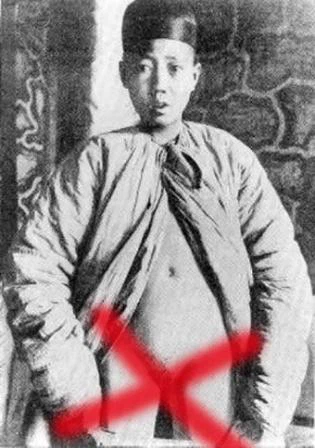
From the reign of Zhu Yuanzhang onward, every Ming dynasty made heavy use of eunuchs. Agencies wielding the power of life and death — the Eastern Depot, the Western Depot, the Directorate of Ceremonial — were all controlled by eunuchs. What did this lead to? The number of eunuchs swelled enormously, and most of them had castrated themselves. In 1424, Zhu Di issued an edict declaring that anyone who castrated himself would be charged with the crime of unfiliality. Later emperors repeatedly reiterated that self-castration was forbidden, but such prohibitions were essentially useless. At the same time, employing all these self-castrated men created an enormous fiscal burden. According to historical records (New Sayings of the Glorious Dynasty, vol. 4), when Li Zicheng’s forces breached Beijing in 1644 (the seventeenth year of the Chongzhen reign), the total number of eunuchs was no fewer than 100,000. What an enormous number this is… It also gives some sense of just how anxious life was for the common people of the Ming.
Regardless of what mindset led these castrated men to mutilate themselves, or to be subjected to castration, they were all incomplete — one could even call them deformed. Setting aside historical reasons, their physiology differed from normal people’s: they had no genitals, and so could not have a normal sex life, yet on the other hand they desperately longed to become “normal” again — for instance, it was often said that some eunuchs kept their own beautiful young concubines. And the court relied heavily on these very men, having them make arrests, conduct surveillance, and carry out interrogations. Shen Defu’s Unofficial Gleanings from the Wanli Era, volume six, “Debauchery Among the Palace Eunuchs,” records that when Ming eunuchs were castrated before entering the palace, only their testicles were removed. One eunuch, in the midst of having intercourse with a young opera performer, forced his unable-to-fully-rise penis into the boy’s anus — only to find he couldn’t pull it back out, and his penis kept swelling larger and larger inside. The boy eventually died from the pain, and the eunuch was sentenced to death. I have no way of knowing whether this particular account is true, but it reflects the author’s disgust toward eunuchs — disgust strong enough to devote an entire column to condemning them.
There’s a witty remark perfectly suited to eunuchs: “I pity you, yet I also find you shameless; I find you shameless, yet I also pity you.” You look at the world, you scrutinize the world, with incomplete bodies and deformed minds — and that is disgusting. The ancient Greek philosophers placed great weight on linguistics and rhetoric, seeing them as the path to truth; thousands of years later, Dominique Laporte likewise discovered that “language only becomes language once it has been castrated” (History of Shit) — which also explains why the French word for “language” (langue) is feminine, and which in turn seems to offer a “rational” basis for the literary inquisitions of the successive Ming reigns. So perhaps it’s still best to follow the old saying: “Be sparing in speech, diligent in action.”
In mainstream culture, men who are handsome, sunny, healthy, and wealthy are the most popular — everyone knows this. Many people, worn down by the passage of time, wait for someone to appear, but really this is just obedience to mainstream culture, a choice made within its terms. “I searched for her among the crowd, a thousand, a hundred times” — and “crowd” means many. So accumulating as many mainstream-approved values as possible is the only sure way to raise your own value in the great army of mate-seekers.
Lately I’ve heard many people’s stories from the process of choosing a partner — stories about choices that left them deeply stuck, unable to climb out. And these choices turned what once counted as “added value” into useless scrap under a different kind of logic.
To put it simply: A has feelings for you, B has money. People often find it hard to choose — cultivate feelings with A, or build wealth with B? The dilemma this binary choice creates is like the philosophers’ endless, fruitless debate over matter and consciousness — vexing and inconclusive. The latter is often seen as worldly, materialistic, tasteless, without aspirations; the former, starting from nothing, is often daunting. With the latter you can slowly cultivate feelings on a material foundation; but no one can say for certain how much money it takes to buy love. Certain chemical reactions in the latter case can be regulated through cognition; the former seems to arrive as if by nature itself…
Throughout history, there has been very little that could truly be called love. Of course there’s no shortage of people who speak of “love,” but I suspect what they’re talking about is rarely love at all. Sometimes I envy those who are capable of loving — envy the earth-shattering, the die-for-you, the everlasting, the sea-drying-up-and-rocks-rotting kind of love. I think about their love too, turning it over and over in my mind, turning it over and over — but in the end love is just love. It can’t be deconstructed, can’t be analyzed, and can’t be redone.
Li Longji loved Yang Yuhuan — he fell in love with incest. Zhuo Wenjun loved Sima Xiangru — she fell in love with rebellion. Rose loved Jack — she fell in love with his wildness… There are too many love scripts to count, exhausting to recount, and few people really understand them. But we can find one rule running through all of them: love always comes with an added condition. Perhaps incest wasn’t the sole reason Li Longji fell for Yang Yuhuan, but it was undeniably present — you can’t say incest had nothing to do with why he loved her.
Put simply: suppose there are two events, A and B, and they’re highly correlated. What can we conclude? Does A cause B? Does B cause A? Or do A and B simply happen to occur together, with no real relationship between them?
The process of falling in love is this: person A falls in love with person B by way of some added condition X. X can stand for many things — money, status, looks, star sign, blood type, personality… It might be a single factor, but more often it’s a composite of several. What’s certain is that X always exists. Person A might claim, in good conscience, that God made them fall in love with B — but that’s just a verbal sleight of hand, skipping over the existence of X. It’s like someone who refuses to touch money asking someone else to go shopping for them, just to preserve the appearance of never having sullied their hands.
This model of love isn’t a new idea — it simply illustrates that love requires conditions. Zhang Xiaoxian wrote an essay called “Love Is Always Conditional,” which interpreted this same model from an emotional angle. Setting aside the thick warmth and tenderness, if we examine the relationship between condition X and love, it’s not hard to see they’re highly correlated — we might even say it’s X that produces the love in A, not B herself. Between any two lovers there are always gaps and trenches that need filling in, and clever Huang Rong and honest, simple Guo Jing filled in each other’s gaps together — and so they fell in love.
Love may be a sublimated form of the barter system of primitive society. There has never been, in love, any single true destined other proclaimed by mystics — only the principle of matching supply to demand and the evaluation of a value curve. Person A and person B are nothing more than two parties who happened to meet in the long river of love and successfully traded goods. The loading scenes in so many films are interesting in this regard — and lovers are just like that too, bundled up together and loaded onto a truck, bound for the road of marriage, the road of reproduction, the road of aging, the road of death.
So: I love you — really, it has nothing to do with you.
A couple of days ago I shared an article on the campus network about how to confirm one’s identity as gay, and a friend wrote back saying the social pressure was too much, that she wasn’t going to be a “T” anymore, that she felt it wasn’t sustainable. It reminded me of a case that went the opposite way — a video that circulated online a few years back, in which a sixteen-year-old boy said he’d realized he was gay at age eleven, and that it was precisely this identity that had made him stronger, more attentive to others, and through it he’d found “the brilliance of life.”
Some historians agree that history doesn’t allow for hypotheticals; in the same way, sexual orientation cannot be hypothesized either (though, that said, sexual orientation is a deeply subjective matter — in other words, you can become whatever type you want to become). So, whether it’s my friend’s words or the words in that video, to me, neither carries enough persuasive force. We cannot use the fixed perspective that comes with one identity to guess at or speculate about other identities. Plenty of people think gay men are sissies or gay women are tomboys — and this absurd mistake comes precisely from peering at homosexuality through the lens of a heterosexual identity!
A little over a year ago, after If You Are the One came out, Li Yinhe published an essay reflecting on it. In it, she pointed out that homosexual characters could be cast as the protagonist — the “hero” — in films with otherwise general subject matter. This looks, on the surface, like a positive social model, one that could change how the public views homosexuality, but to my mind there are still some problems with it.
There certainly are “heroes” among gay people (quite a few brilliant designers and photographers fall into this category), but in certain senses society manages to sidestep this entirely. The public, for instance, always seems to associate gay people with AIDS. Someone’s otherwise “special” gay identity gets dragged into public view only because it’s been linked to a disease. The identity of being gay is so often presented in a way that tilts toward death — truly an unspeakable sorrow!
What’s more, pinning the arduous task of reversing public consciousness on film and television isn’t a particularly reliable approach — any character, however formed, goes through “countless” rounds of polishing and revision, and this is true not just for the great and famous, but for minor figures as well. An overly polished, overly dressed-up image of homosexuality might end up draining away even our most basic compassion and sympathy.
So in what way should the identity of being gay actually be represented? That’s not a question I’m in a position to answer. But plenty of people in everyday life offer us inspiration — like the deaf-mute performers of the Thousand-Hand Guanyin dance on the Spring Festival Gala years ago, who moved everyone through their grueling training. In the same way, as a group that mainstream society tends to sidestep, gay people should come to understand, respect, and continually perfect themselves. Yes — the man-made Jesus isn’t going to save you. Only self-salvation will.
My modeling exam just ended, and I haven’t had much time to look at anything lately, so I’ve just tidied up a few notes from the past several days — call it a bit of “more trouble than it’s worth” leftover sentiment, offered as a coda to an earlier post.
One.
In the days right before a school break, or right before exams, we always feel there’s a pile of things we should have done but haven’t — like holiday homework that gets crammed into those last few days, or exam review that gets squeezed into those last couple of weeks, while everything else just keeps getting pushed off to “tomorrow.” This process is rather like the body digesting a great deal of waste, passing it through one organ after another, until it finally lingers at the anus, right on the verge of coming out. So I call this the anal effect.
Two.
When we use set phrases, we’re always just using them out of habit, never out of habitual analysis. It’s a bit like how a lot of people learn Photoshop — they just copy the parameters in the tutorial without ever asking why those settings are used. And so “spouting blood from one’s mouth to slander someone” gets reinterpreted as “a woman giving birth,” “wind rising from an empty cave” becomes “a bare-bottomed woman running,” and with the even more absurd case of “the day will come, the road is long,” people’s attention lands squarely on the second character… This sort of thing happens constantly, too much to list. But looked at from another angle, expecting people to dig through dusty old allusions every time they use a set phrase is, frankly, unrealistic.
Three.
In The Lover, Marguerite Duras describes the Chinese man who gave up love for the sake of family and money like this: “He must have, through deceit, found himself again within this woman, and through deceit fulfilled everything that family, heaven, and the ancestors of the north demanded of him — namely, the continuation of the family name.” Love yields before marriage just like this, and reality discards the ideal in the same breath. I don’t know what it meant for Duras to receive that phone call. Thinking it over, if it had been me, I think I’d rather have just hung up — better that than to keep thinking about it, better that than to keep remembering.
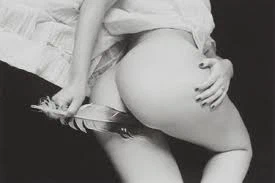
by Ralph Gibson
Four.
No one born into this world escapes the fate of “comparison.” The moment you’re born, your mother is delighted if your cry is louder than other babies’; in school, the kids with good grades always get more praise; once you start working, earning more than others gets you more of the complicated things in life… even in death, a grander funeral or memorial service than other people’s is supposed to bring more comfort to the soul. Take a moment to really turn this over in your mind — what does comparison actually bring? And what does it take away? As for me, I think a little restraint is for the best.
Five.
There’s a Chinese saying: “Raise sons to provide for old age, store grain to guard against famine.” Analyze that sentence a little, and you’ll see that both “sons” and “grain” are being treated as a kind of commodity, stockpiled to ward off bad things that haven’t happened yet. This is exactly the old-fashioned Chinese philosophy of raising children. There have been posts circulating on the campus network calculating, say, the “cost” of marrying a Beijing girl, going on about how much marriage costs and so forth. And yet — even though a daughter is supposedly “water poured out, never to return,” she turns out to do a pretty decent job of providing for old age too. Does that count as equality?
Six.
Speaking of which — the wolf disguised as the grandmother, is it really a wolf, or is it the grandmother? Only the wolf itself knows for sure. And what’s even scarier is that someone can be a kindly old grandmother one moment and a vicious wolf the very next. Following this line of thought, I find myself increasingly doubtful about what art-house films are even supposed to mean. Maybe they’re just a bunch of awkward films that don’t fit anywhere else, lumped together into a little pile, given a name to make their existence seem reasonable — and that’s what we call an “art film.” But then the question comes right back: once you peel off that label, what’s left underneath?
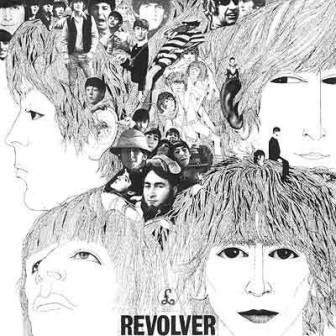
I’m not really into rock, but this album I love beyond words — I genuinely can’t explain it. Anyone with even a passing interest in rock will find the name “the Beatles” thunderously familiar. Yes — they stopped being just a band a long time ago. They are the Beatles, they are a culture, they are a byword for a legendary era.
That generation of rock-and-roll kids was so fervent, so soaring, so free, so optimistic. It suddenly strikes me how grateful I am that they existed — in this tangled, overgrown society, that I can still hear their pure, lovable voices feels like a real redemption, a real comfort. I wasn’t born in the sixties, and I wasn’t lucky enough to be born in the seventies or eighties either — I was born in the early nineties, branded with the label “post-90s.”
A fervent, fanatical propaganda poster — long live Chairman Mao, ha!
Right now, I find myself hysterically nostalgic for the sixties. I want to grow my hair into a long mop and howl “She Said She Said” at the top of my lungs; I want to shout “Long live Chairman Mao” beneath a sky full of fluttering flags. I want to march with French students in their student movements; I want to take to the streets in a frenzy with the hippies… The pity is that the times are no longer the sixties, and I am what’s called “post-90s.” We indulge ourselves recklessly; we fall silent and say nothing. We march forward optimistically; we grow weary of the world and despair.
And yet, in the end, we can never be as simple and pure as you were. I’m truly envious of the people of the sixties — you got to worship Chairman Mao as a god, to believe in him so fiercely you couldn’t pull yourselves free. Let me borrow a line from Marilyn Coffey’s essay, collected in The Sixties (Tianjin Academy of Social Sciences Press, 2000): Oh! How enchanting! This is how life moves forward! This is how life refuses to be abandoned!
The moment I got on the bus today, I was blindsided by a post recommended on the homepage, “Take Heart: Revelations of the Leftover Warriors.” The piece is mainly about the problem of “leftover women” and “leftover men” — a term that’s actually become a catch-all label for a whole range of people. As the economy develops and ideas about childbearing keep shifting, more and more “leftover men” and “leftover women” are appearing, and various anxieties about it are gradually surfacing. I’m reminded that, around this year’s International Women’s Day, news that the number of “leftover women” in Beijing had topped 500,000 — making it number one in the country — was widely circulated (click here to read). Within this “special population,” most are worried about their own “reproductive future” (a term I made up myself), but I believe some of them have genuinely had their minds liberated. Though they remain single, they don’t see it as a source of distress — quite the opposite, they’re remarkably relaxed and at ease. But when all is said and done, within the consciousness imposed by today’s society (or perhaps it’s a stereotype), the word “leftover” has nearly become a taboo, and these pitiable leftover men and women have become monsters that people frantically try to avoid.
Rational discussion drifts far away from reality, the way certain abstruse talk detaches itself from people’s actual lives. Looked at this way, you could say it’s all empty words and nonsense, a way of evading the real world. But why is it that politics, the state of the world, China, human nature, reality — why do these things so bitterly trouble certain people, and yet fail to trouble the “numb ones”? I say: since the outside world already makes people suffer so much, all the more reason to keep enriching one’s inner self — otherwise you suffer both inside and out.
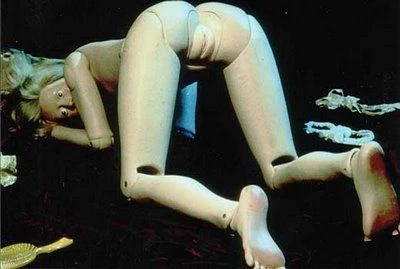
Cindy Sherman; the famous 1987 work Untitled #175. This doesn’t read as a simple expression of misanthropy — the vomit and refuse in the image feel more like a kind of “female protest”
After nearly two years at Sichuan University, the books on my shelf have gradually multiplied. Looking at the piles of academic books that fill me with despair, alongside the beautifully bound translated novels, I find myself thoroughly annoyed. Walk into any bookstore of decent size and you’ll see that famous line — books are the ladder of human progress. But are books really so great? Think about it carefully: a book is nothing more than a vessel carrying human thought. What we actually need is the thought recorded within it. Once that knowledge grows old, once times change and new knowledge keeps emerging, old books become obsolete even faster than old knowledge does. At that point, aside from satisfying our quasi-necrophilic nostalgia, what meaning does the book itself still hold?
Living as we do in an age of extreme informatization, can our lingering attachment to old books really evolve into the kind of devotion Yeats describes in his famous poem “When You Are Old” — growing old slowly together with you? Perhaps that’s far too idealistic. Just as the foul air accumulating in the body eventually needs to be expelled, once old books pile up high enough, they too need to be dealt with. But what I fear most is exactly this process of “sorting the genuine from the false,” of selecting and discarding. Or rather — beyond the knowledge itself, these books also hold fragments of my own past, every joy and sorrow contained in every volume, every page, chapters of life touched by a faint, lingering fragrance. If only there were some parallel dimension where I could store everything I’ve left behind in each moment of my life — like Doraemon’s jars, used to store the four seasons separately. Unfortunately, faced with stacks of old books, I still have to make a choice, and that’s when this thoroughly unsatisfying nostalgia flares up again.
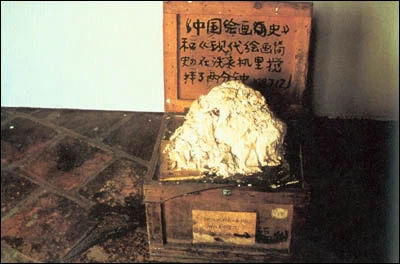
Huang Yongping’s once-sensational work, in which he placed A Concise History of Chinese Painting and A Concise History of Modern Painting in a washing machine and ran it for two minutes, seems to offer one possible solution — like a performance artist, blending the two books together. But I still lack the nerve, or perhaps I doubt whether there’s really any value in blending them together at all. In fact, what Huang Yongping shows us is that what’s now called “art” doesn’t need any “accumulated weight of history” — it only needs to be relevant to the present. So could this approach catch on?
In truth, looking across the vastness of the world (again, far too idealistic a way to put it…), the answers to the problems we encounter are usually already brewing within those very problems. Take something as iconic as the college entrance exam: the moment the test is over, those once-treasured reference books instantly become worthless scrap. Some students sell them, others burn or tear them up… even whip them with sticks. I imagine the ancient practice of “book burning” arose under similar circumstances. But to me, the methods above feel far too “violent and bloody.” It seems the best way to avoid producing more corpses is simply not to produce more living things in the first place. If that’s the case, will the corpses of books ultimately turn into an “indictment” against me as well?
Confirming one’s “identity” is an extremely difficult process. Whether one is heterosexual, homosexual, bisexual, or somewhere between the two, the attempt to confirm exactly what kind of identity one holds is a painful yet wondrous experience. The process is as strange and astonishing as an aquatic creature gradually evolving to live on land. The reason it’s so hard to judge — or rather, the source of our distress — is that the responses we produce are almost always reflections of our outer self, and it is precisely within that outer self that a “true self” can scarcely be found.
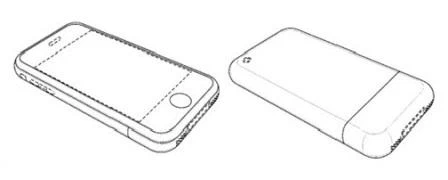
Apple filed a design patent for the iPhone. Industrial design is also a weak point for China
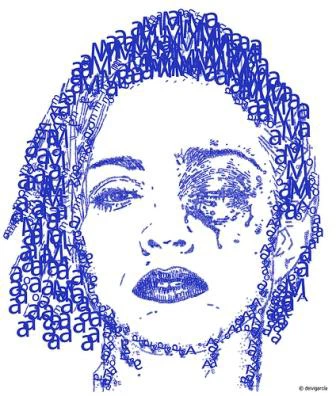
Typographic creativity is a major shortcoming in Chinese design. Walk down any street and you’ll find the same familiar styles everywhere. The signs above shops, the advertisements lining the sidewalks — almost all of the typefaces used are simply pulled from computer font libraries. From the imposing signage of “Such-and-Such Bank” down to the unremarkable little shops tucked into countless side streets, it’s all the same. The owners of these storefronts, with the convenience technology affords them, have turned the street into an exhibition hall for computer font libraries. Song, Hei, Kai, Fangsong… they wash over the eyes of passersby in a uniformly templated way.
From Flickr
Search Flickr using the keyword “street typography” and you’ll find a wealth of wonderful “signage” from abroad — most of it strikingly original and exquisitely crafted, far more interesting than the convenience-driven, templated “design” we’re used to seeing here. This isn’t an idea that came out of nowhere — I had a similar feeling once before, while looking through 500 Book Covers. Now that we live in a thoroughly digitized society, where people can reproduce and disseminate text with a computer so effortlessly, who would still choose the slow, traditional craft of hand-lettering?
The psychology of fearing authority is by no means unique to any one person — everyone has it to some degree, and Chinese people seem to suffer from it especially badly. So many matters of judgment and discernment require some “master” to “open a forum” and lecture us, so that we can hear what the master hears and think what the master thinks.
Yesterday Sina Tech published a piece of news: “Are Earthquakes Really Becoming More Frequent?”, which argued that “in recent years seismic activity may be somewhat higher than the long-term average, but it still hasn’t departed from the normal range.” This news item originally appeared on America’s LiveScience website. I have no idea whether it’s accurate or authoritative, but I’m certain that the moment people see the words “American LiveScience,” they feel as though they’ve received sage counsel, and their worries gradually dissolve.
Likewise, some parents see that Lang Lang or Ding Junhui never finished school and instead trained relentlessly to become masters of their craft, and they rush headlong into pulling their own children out of school, forcing them into grueling practice. Yet neither Ding Junhui nor anyone like him ever claimed that dropping out of school is a prerequisite for success. Still, the public is remarkably adept at distilling the life stories of successful people into a formula, and forming an “implicit” pattern of imitation.
This is all the fault of blindly following “masters”! Seen this way, the “leaf” that blocks one’s view in the old saying about a single leaf obscuring the eye is, more often than not, exactly the kind of person who merely appears formidable.
After finishing Synecdoche, New York, I was drawn back into a long-standing confusion of mine — or perhaps of humanity’s — death. What exactly is death? A spirit, a culture, something we project our longing onto? Or is it the mourners left behind, grieving, the wreaths of yellow and white flowers, the feelings hidden behind an elegant tombstone? It seems to resemble so many of humanity’s emotions: just as mysterious, mysterious enough to inspire fear, so that people are reluctant to even speak of it; just as overwhelming, always provoking endless contemplation, endless elegy. But all of this is merely the surface of death, because I myself cannot see through to its core.
The Ci Hai dictionary has a clever trick: when defining certain nouns and adjectives, it always defines them by their opposite. When explaining “fat,” for instance, it says it’s the opposite of “thin.” Naturally, in explaining “death,” it uses the same clever device — the opposite of “life,” of “being alive.” But experience tells us, again and again, that life does not end with death — at least not on the psychological level. It’s said that certain mediums can photograph the souls of the dead, which has stirred enormous controversy within parapsychology. Of course, experts accustomed to the standard, scientific photographs of the laboratory mostly scoff at these supposedly paranormal images, dismissing them with contempt. Indeed, whether these things are fact or fantasy, to science they amount to nothing more than “an ant trying to topple a tree” — yet they nonetheless show how persistently people manufacture and propagate death, or half-death. By contrast, we habitually subject stories about “life” to scrutiny by reality — those who spread rumors we call “rumor-mongers,” those who tell bizarre tales we call “delusional.” Yet legends about “life” are everywhere around us, and most of them are voiced through collective consciousness — we are constantly told that in such and such a year the economy will improve, that we will live happier lives; more absurdly, the ideas propagated by certain films suggest that some people are simply better than others and ought to save this group or that; and most absurd of all, some people’s words have actually come to be treated as “scientific thought,” carrying everyone along in a shared delusion.
We all know that the concepts of fat and thin, big and small, good and bad are not absolute. Yet it’s precisely “life” and “death” that carry the heaviest, most primal distinction — there is, it seems, an absolute dividing line: with one cut, the heart stops or the brain dies, and “life” instantly crosses over into “death.” This strikes me as utterly inconceivable. I understand the weight and shock of death, of course, and I believe in it — but I am even more convinced that “absoluteness” cannot truly exist in anything, anywhere.
But does this world really contain a state of being “half dead, half alive”? I imagine anyone trained in medicine would be powerless to answer. Judging life and death this way is rather like judging male and female by gender alone — too arbitrary, too detached from reality. In matters of gender, the existence of intersex individuals already breaks down the boundary between male and female. What about life and death? As far as I know… no one has ever died, then gotten back up some time later to tell us what death felt like. Does that alone prove the distinction between “life” and “death” is sound? I don’t think so. If the life/death divide is supposed to be more scientific and rigorous than the male/female divide, then how do we explain all the legends of ghosts and spirits that persist (setting religion aside)? Moreover, we can loudly declare “I am a man” or “I am a woman,” yet almost no one ever says “I am a living person.” Of course there’s a cultural taboo at work here — we habitually avoid the subject of death — but is this avoidance really born of fear of death, of fear of losing “life”? Or is it that we fundamentally cannot discern the true nature of life and death at all?
When capital began to be privatized, the psychological fear of loss emerged — or rather, began to be magnified and intensified. This sentiment quickly generalized, spreading from people to objects and beyond, eventually reaching concepts like “life” and “death.” The earliest humans had no idea what death was. Somewhere on earth (I no longer recall exactly where), archaeologists once discovered a strange burial practice: the dead were buried face-down with their bodies curled up. It’s been surmised that this posture resulted from the body having been bound. So why would anyone bind a corpse? The answer is simple: because, at the time, people didn’t realize the person was dead! They still treated him as part of their daily human activities, but decay inevitably set in, and out of fear — that most primal of human emotions, as I mentioned before — they buried him, yet feared he might somehow respond again (come back to life), and so they bound him. Chronologically speaking, this is the earliest “funeral rite” humanity has left behind.
Cultures around the world all take measures to avoid confronting death directly. In China, for instance, when someone has truly died, we still tend to use euphemisms: “they’ve gone,” “they’re no longer with us,” and so on. Mourning for the dead is something imposed by culture, while death itself precedes culture. On this point, I agree with what Haruki Murakami wrote in Norwegian Wood: death is not the opposite of life, but exists forever as a part of life.
Religion always instructs us to do good and accumulate virtue so that we may ascend to heaven after death — in reality, this is meant to ease people’s fear of the unknown, of death. Naturalists, for their part, emphasize letting nature take its course, passing through death calmly and peacefully — which, in effect, is also a way of diluting the concept of death. Freud, that analytical madman, is probably the first person I can think of who brought death up close. He classified death as one of humanity’s primal instincts, calling it the “death instinct” (as opposed to the “life instinct”) — for example, humanity’s tendency to wage war and destroy is, in his view, a direct expression of the death instinct. Not long after Freud’s ideas held sway, humanistic schools of thought — parapsychology, transpersonal psychology, and other doctrines connected to “spirits” — began emerging one after another… the paranormal kept resurfacing, like a ghost that simply refuses to disperse.
Death really is like this — leaving us utterly at a loss for words, yet at the same time filling us with dread. This, I think, is the essential nature of all mysterious things. Once you peel back death’s many veils, perhaps it really is just as the Ci Hai says: merely the opposite of life, merely a definition humans have assigned to something. Put more plainly, it’s nothing more than a disease everyone eventually contracts — a disease that no amount of effort, across however many years or generations, has ever managed to cure. Or perhaps, like “life,” it too is merely a matter of form — its product simply invisible to us.
The Ciyuan dictionary (Commercial Press, 1979) says, “To prove is to establish truth or falsehood based on fact.” Breaking that down simply: the “fact” is the necessary condition, and “truth or falsehood” is the result. For a careful “prover,” this process is already fixed in advance, so how one goes about “proving” becomes the key to establishing the final truth or falsehood. Arguing with a classmate recently, we each used reasons slanted in our own favor to “prove” our own “truth.” Under such conditions, with everyone’s judgment “clouded by self-interest,” what correctness could there possibly be?
This kind of proof method shows up constantly in the news – many vicious incidents get “proven” using exactly this technique. After briefly recounting the course of events, the reporting moves smoothly into the perpetrator’s broken family history and background, as if to declare a fact: that everything he has done now is simply because his family was such-and-such a way. But what about the influence of society? Why does this era keep producing so many of these “special” individuals, one after another?
Looked at this way, proof turns out to be quite unreliable. Its starting point is never anything more than supporting certain things, or opposing certain things. Perhaps certain facts do confirm it, but unfortunately we’ll never know exactly which facts those “certain” ones are. The Shanghai Classics edition of the Cihai dictionary adds an explanation to the entry for “proof”: “Proof, also called argumentation, is the thought process of establishing the truth of one judgment based on another judgment already known to be true” – which seems to explain the first definition in greater detail, but doesn’t this, too, amount to protesting too much?
A few days ago I finally watched Miyazaki’s 2009 film Ponyo on the Cliff by the Sea (崖の上のポニョ), in which the little mermaid Ponyo and the boy Sosuke end up together and live happily ever after. I hadn’t even had the chance to remark on how naively fairy-tale-like the film’s ending felt before reality hastily handed me a horrifying piece of news. That’s right – fairy tales are usually wonderfully, foolishly naive, while reality is so often dark and cold.
Nine days ago, a murder happened at Sichuan University. Zeng Shijie, an undergraduate in the Information Resource Management program, class of 2008, in the School of Public Administration, killed a female student and injured two male students by Mingyuan Lake on the Jiang’an campus. At the time, our class advisor gave us some so-called ideological education during a political theory class, telling us the school would resolve the matter satisfactorily. But after a few days, there was no follow-up at all, and no one seemed to care whether things had been swept under the rug. Then, on the night of the 7th, two male undergraduates from the same class and same dorm room in the School of Economics, class of 2008, got into an argument; one of them, surnamed Chen, used a fruit knife to injure the right carotid artery of the other, surnamed Wang, and the victim eventually died from blood loss despite emergency treatment. (original article).
Incidents like this keep happening, and they leave us with essentially two possible reactions: shock, or numbness. Of course, maybe there’s a third – a kind of morbid excitement. Many people place the blame on the perpetrator’s “criminal psychology” or “reckless behavior,” but I think there’s no longer much point in assigning responsibility – first, if psychological issues were never addressed, the school bears the greatest dereliction of duty; second, anyone capable of an act like this has already departed from the realm of norms, and their nature and character can’t simply be dissolved through “understanding,” because what drives them comes from the most primal emotion at the bottom of the human heart – fear. Of course, I admit this view of mine may be overly harsh and not without its own bias.
Ponyo on the Cliff by the Sea, as always, gives everyone a fairy-tale-style happy ending. The red-haired woman, who symbolizes the boundless power of the sea, delivers everyone from suffering like a saint. Meanwhile, in The Little Mermaid, the beautiful mermaid princess can only let her body dissolve into sea foam, her corpse floating up beneath the crisp morning sunlight, wringing more than a few tears from us.
All in all, our understanding of sex is far, far too limited, especially among certain people. But exactly which “certain people” I mean, I can’t quite pin down for now – maybe it’s the less educated, who only know about sex as a means of producing children; or maybe it’s the highly educated, who treat sex as a kind of sin to be painstakingly avoided… But I can say one thing for certain: confusion about sex is a problem for the entire nation.
On March 24th, a man in Nanxi County, Sichuan, was fined 3,000 yuan for downloading and viewing obscene material at home. According to the relevant provisions of the Measures for Security Protection Administration of International Networking of Computer Information Networks, issued by the Ministry of Public Security in 1997: no unit or individual may use the international network to produce, copy, browse, or transmit obscene or pornographic information. Merely browsing it is already against the law. (original article)
Similar incidents have happened before. As far back as 2002, a couple in Yan’an, Shaanxi, had their door broken down by police and were arrested for watching pornographic videos at home. On September 12 and 18 of 2008, Ren Chaoqi and Tang Shanghai were respectively convicted and fined for distributing and copying obscene videos. Netizens were all watching closely for the outcome, expecting – the way we’ve all been taught to expect since childhood – that “evil cannot prevail over good.” But in these cases, who exactly is good, and who is evil?
There are plenty of people who download or distribute pornographic videos – there are quite a few even among the people around me (oops), so by sheer numbers we make up the majority. And yet the law has forcibly intervened in our private lives – there’s simply no privacy left! Of course, the police have a strong and powerful backer – the law. Anyone who dares go up against the law is asking for trouble; refusing to comply is basically a form of self-destruction.
Many people have tried arguing with “the law” on its own legal terms. Article 68 of the Law on Penalties for Administration of Public Security stipulates that penalties apply to those who use computer networks, telephones, or other communication tools to distribute obscene information – it says nothing about keeping such material at home purely for one’s own viewing, which doesn’t violate the relevant provisions. Going further, the constitution guarantees the right to freely read all sorts of books and browse all sorts of websites – this is a citizen’s right to personal freedom, a citizen’s sexual rights. (Li Yinhe, “In Defense of the Underclass”).
But in my view, in a China where both politics and the rule of law are this chaotic right now, saying any of this to “the police” is like playing a lute to a cow. Of course, the entire nation’s sexual consciousness is confused, so it’s understandable that such pointless things keep happening – and perhaps someone will ask again, the way people used to: “who will be the next ‘man from Nanxi County’?” Really, everyone should just wave it off, laugh at the increasingly absurd state of things, go home, and – like in the picture – make love to a mannequin instead. Wouldn’t that feel a lot more satisfying?
Browsing eDonkey last night, I found a BBC series introducing the Galapagos Islands – what a wonderful place that is… I looked up some information and learned that the largest living tortoise species in the world lives there – the Galapagos giant tortoise. This species was actually a major source of inspiration for Darwin’s theory of evolution.
On Pinta Island, in the northern Galapagos, only a single giant tortoise remains, named “Lonesome George.” In 1972, an expedition discovered him on Pinta Island and brought him to the tortoise conservation center on Santa Cruz Island. In 2008, the over-90-year-old George suddenly found himself in the mood, mated with two female tortoises, and produced 11 eggs. (see the news here)
For 36 years this “Lonesome George” never touched a female tortoise, and all sorts of rumors flew around in the meantime – staff suspected he was a gay tortoise, sexually frigid, or infertile. Fortunately he finally mounted a female, and I imagine those doubts can largely be put to rest now. At the very least, the species has been carried forward.
Some scholars have pointed out that most of humanity’s sexual behavior isn’t actually aimed at reproduction, but its underlying purpose mostly still is. Not only that, but people are also constantly anxious about the reproduction of other species. Whenever I hear the phrase “on the brink of extinction,” my heart always tightens a little, wanting to know what animal or organism it is this time. Now I suddenly find myself a bit irritated by it – to put it plainly, it’s all just humanity’s own “duty to carry on the line,” displaced onto other creatures.
When I think of women, the first thing that comes to mind is menstrual blood. Maybe it really is the womb’s tears, carrying, like death, an immense sense of weight. The second thing is all manner of supernatural matters – many people are born holding an instinctive reverence for women’s “spiritual power,” the way people always say “virgin’s blood” has all sorts of uses, preserving youth forever, summoning spirits, and so on. That scene in Baise-moi… no, in The Anatomy of Hell, where they drink each other’s menstrual blood together, shook me for a long time.
Throughout European history, countless witches were burned by religious tribunals – supposedly numbering in the millions. In truth, most of these so-called witches were biologists, chemists… it’s the same old story: if only Madame Curie had been born a few hundred years earlier… But setting aside the historical record, there really is some particular quality in women that I genuinely sense at times – I believe women are able, at certain moments, to pick up on strange omens for no clear reason at all.
I recently came across the work of two female photographers, Claude Cahun and her lover Marcel Moore. Their work captures the feminine quality so well – rebellious, eerie, deconstructive all at once – those thin images brimming with mysterious elements left a deep impression on me. And women’s writing deserves mention too: to me, women’s prose is sensitive and delicate, carrying a lingering uniqueness that men can never manage to imitate, no matter how hard they try.
Women really are quite complicated. Looking back through history, it’s often women who have stirred up the greatest storms – though of course there’s also the factor of upholding patriarchal society at play in that. But in any case, women keep becoming more mysterious to me. Can a woman really be equated with a witch?
I recently read some of Luo Yufeng’s poems, and both their mood and language are rather interesting – pieces like “Drifting Clouds” and “The Sorrow of Thought.” And yet, people online still find it hard to give her poetry any credit, picking apart everything from professional poetics to internet vernacular to find what’s “off” about it. This is a common phenomenon – when people perceive things, they tend to “generalize from a part,” what psychology calls the “halo effect”. Everyone tends toward the same notion: that beautiful poetry should come from the hand of a beautiful, captivating talented woman.
Appearance is supposed to be the vessel of wisdom. Yet plenty of evidence warns us that, without a positive exterior to set it off, the glow of wisdom and virtue dims considerably. In the era when red dominated everything, how many Chinese people were tormented by the concept of “inner beauty” – educated on one hand to believe in it, while on the other hand tempted by beautiful female spies whose hearts were supposedly not so beautiful. Who knows how many people cursed them aloud while secretly fantasizing about them in private. Suppose, hypothetically, that their stunning looks vanished and ugliness took their place – would people hate them even more?
On the other hand, how exactly are we supposed to judge Luo Yufeng? Who has the right to judge in the first place? By our usual way of thinking, the people qualified to offer judgment tend to be the learned, the authoritative, the highly skilled professionals. Take Luo Yufeng’s poetry: those who judge it good or bad tend to be people who “really understand” poetry (from various angles), while everyone else is expected to step aside, unqualified. But the starting point of poetic criticism rests on one’s own individual aesthetic sense – is even aesthetic sense itself something held only in the hands of those “superior” people?
And yet, even when we examine things sincerely, on our own terms, bias is still hard to avoid. When we say Luo Yufeng is too self-confident, have we ever asked whether we ourselves are never overconfident? When we say someone isn’t good-looking, is that judgment built on the assumption that we ourselves are good-looking? We should understand that very few people, when judging another person or thing, ever weigh their own qualifications first before offering an opinion suited to their own standing. Of course, exactly how few “very few” really is, I have no idea, nor do I know how many people have seized or castrated the right to speak.
In short, judgment is complicated. The mechanisms that trigger our reactions to beauty and ugliness, good and bad, superior and inferior, leave people with a tangled, ever-shifting perception – even our view of the same thing can change at different times, which is both maddening and amusing. Be careful when you pass judgment. As for what Luo Yufeng is really like, I can’t say for sure – but if you choose to believe entirely what’s said online, that Luo Yufeng is a fool, then living by the spirit of “better to feign ignorance” is, after all, the easier way to go.
It’s been two days of physical therapy now, back to the running-back-and-forth-to-the-hospital state I was in at the start of the semester. Lying on a warm hospital bed, receiving a moderate electric stimulation, I actually felt a bit dazed.
I started to wonder what kind of space-time I actually exist in. Some people would say, don’t we have calendars, phones, and the like to tell us the time? Sure — the bottom right corner of my computer desktop clearly shows the time right now, the year, the month, the hour, the minute. But I’m still not satisfied. I don’t believe in time. I don’t believe it flows linearly, I don’t believe it definitively divides past from future, I don’t believe I exist within this “time.”
The famous Einstein gave time a rather poetic description: time is curved. When you stand at one end of time and look back at the beginning, things at the other end might really appear vividly before your eyes. There’s a line of verse that goes: back then, it seemed only ordinary. Bygone time appears like this, suddenly, at another point later on — coming hastily, and leaving just as hastily. So much of our longing, our reminiscing, springs from these glimpses of old time we catch.
There are many triggers for these images — most often a sentence, a face, a song… These things get processed by your current experiences. What we call being “moved by a scene” or “reminded of someone by an object” arises from this processing of such things. But often the “old” thing being processed was never something we actually possessed — so why do we long for it?
When Hacken Lee sang “Heart Scheme,” I wasn’t listening to Hong Kong pop — that wasn’t my “old.” When Leo Ku sang his love songs, I paid no attention — that wasn’t my “old” either. When Jacky Cheung released In Love I wasn’t even born yet — even less my “old.” And then there’s The Weavers’ “Kisses Sweeter Than Wine” — that couldn’t possibly be my “old” either… Yet every time I hear these, I’m stirred by the notes within them, and feel an emotional resonance.
The same goes for painting, film, and other art forms — too many examples to list. I think a great deal of “the old” belongs to humanity as a whole — it can cross time, cross races, cross oceans, and be passed on to many people. What was originally just an individual’s emotional release ends up becoming our collective nostalgia. But is this “old” really “old”? It might be, like time itself, simply something fabricated by human beings. Even if you can find meaning within it, is that meaning obtained through a fabricated object?
Or, put another way — where does the meaning of meaning itself lie? I can only sigh — what time brings us really is a strange thing!
Some people may have had this experience: after working out a probability problem, the answer seems unbelievable — how can the probability be so high, or so low? Math majors, when approximating with different methods, sometimes get results that differ by several times over, which breeds suspicion (see p.322, problem 15). To put the question another way: is probability reliable? Is it real?
Here’s a fairly famous example in probability (p.23), put in terms we’re familiar with: if a class has 40 people, the probability that no two of them share a birthday is 0.109. The larger the class, the lower this probability drops — by 55 people it’s down to just 0.01. Think about all the classes you’ve joined over the years — surprising, isn’t it? It shows that probability isn’t always so useful. There are many more examples like this, such as the de Méré problem in probability (p.30).
This is the kind of answer you get from calculating something theoretically. Theory is like an abyss — toss a pebble in and it’s like a tiger borrowing a pig: things go in but never come out. You can imagine that flipping a coin a few thousand times and getting heads every time wouldn’t be such a big deal either. And even setting aside the purely scientific angle, probability is, to some extent, useless.
When using Bayes’ formula there’s the issue of a prior probability (p.64), and that probability is subjectively assigned. Once subjective factors get mixed in, many things change — we automatically delete certain things we don’t want to see, which in effect inflates the probability of certain other things happening. People really do this kind of foolish thing all the time. Take the use of fabricated probabilities in academia — in early psychology research, some people manufactured data like this to “prove” the correctness of their own claims. We always say such people are “not rigorous,” but as mentioned above, rigor isn’t necessarily useful either.
Here’s an example: the probability that we’ll die the moment we open the door in the morning is 50%. But factoring in the chance of a building collapsing, a car speeding out of control, someone’s poorly controlled pet biting you to death… the probability that opening the door kills you would be far higher than 50%. From this, it seems most of us are quite lucky. But when calculating this probability, we subjectively consider only the lethal factors and not the non-lethal ones — if we also factored in the non-lethal factors (the “harmonious society” factor), the probability of dying might become very, very low. So which is the scientific one — the objective 50%, or the subjective non-50%? Looking deeper, in considering whether stepping outside kills you or not, we’re performing something like a “you (not dying)–me (dying)” shift of perspective — should we think with the subjective eye or the objective eye? Does probability belong to theory, or to reality? Seen this way, a lot of what’s in probability really does resemble philosophy — except it’s the damned feelings and data hysterically fabricated by humanity, just there to fool you.
Who really knows? Maybe Bernoulli does.
Reference: Li Xianping, Foundations of Probability Theory, 2nd edition, Higher Education Press
I’ve always held a deep loathing for marriage. During the National Day holiday I went to my sister’s wedding, and it really was an “eye-opener” — at the banquet there were roughly four or five hundred guests, people not seen in decades, relatives barely related at all, all dragged in by a single marriage, even people who were merely acquaintances by name got pulled in too. Sitting in the middle of it all, I felt an indescribable discomfort, like watching a pyramid scheme unfold, or some shoddy private school running a recruitment drive.
I couldn’t understand it — what was the point of all these so-called old acquaintances sitting at the tables, exchanging pleasantries, squeezing out expressions that were neither warm nor cold, neither sweet nor bitter? Back in the summer I’d already heard my mother mention that weddings cost a lot but also bring in income, and that sending out invitations far and wide was a major part of that income. Even granting that parents mean well — swallowing their pride to invite people just to scrape together funds for their children — it’s still nauseating that even this so-called “lifelong matter” requires such personal hustling.
Looking deeper, I feel the institution of marriage has already rotted to the core (even if current circumstances don’t show it outright). This institution has nothing to do with love at all — it’s merely a kind of economic transaction between clans. This view has nothing to do with my own family situation; the underlying harmony there doesn’t lessen my contempt for the marriage system, because we are all being pushed into this terrifying chain of love-marriage-reproduction-death.
In his essay on the vanity of existence, Schopenhauer pointed out that the (passion of marriage or love, etc.) depends on an illusion that makes something of value only to the species appear beneficial to the individual, an illusion that vanishes once the species’s purpose has been achieved. From Jung’s perspective, the existence of this chain is a kind of collective unconscious. I can understand a person being infected by the collective and acting a certain way before they have sufficient awareness; but for someone to go on enacting this chain after reaching full maturity as an individual — that I cannot accept. Must we spend our whole lives living inside this illusion of consciousness?
Whether it’s marriage or reproduction, their existence benefits our species, not the individual. Some will say marriage is the fruit of love and reproduction the continuation of life, that we thereby gain a sense of eternity — which is laughable, because whether we’re the “producers” or the eventual “product,” we all face the same thing: death. From this angle, death is far more eternal than life, yet we fear and flee from death all the same — which shows that the continuation of life is merely consciousness lurking in our cells, not something of real use to the individual.
Perhaps it’s too early for those of us still “children” to discuss such things (though plenty of people get engaged at this age). Perhaps the views above aren’t entirely correct (though there’s no such thing as “correct” here either). But pondering whether there’s a flaw in our consciousness, whether we’re being driven by something latent within us, is a capacity we absolutely need when facing the choices of life. Either way, monogamous marriage is still a fairly absurd arrangement — can it really guarantee that one will never develop feelings for anyone besides one’s spouse for an entire lifetime?
“The left and right eyes see the same object from different angles; the images formed on the retina are not entirely identical. After the brain combines these two images, it can distinguish front from back, near from far, thereby producing stereoscopic vision.” — Baidu Encyclopedia (on stereoscopic film)
I watched an episode of Discovery about the differences in stereoscopic vision among animals. The angular difference between what the two eyes see is the stereoscopic field of view; biologically, a wider stereoscopic field means a faster ability to judge and locate moving objects in space. Large cats, for instance, all have a wide stereoscopic field, allowing them to react quickly to prey movement. Herbivores, by contrast, tend to have a narrower stereoscopic field, because when a predator comes, they usually only need to bolt in one direction, so they don’t need too wide a field. Look closely, and you’ll see that the eyes of predators differ from those of ordinary (hunted) animals. Nothing about how things develop is accidental. Nature is cruel — it forces living things to evolve, and only those who manage to squeeze through the cracks earn the right to keep living.